Back
For Startups

Patents and Indian Deeptech Startup Funding: What a 13-Sector Map Means for Your Round
October 23, 2026

Patents and Indian Deeptech Startup Funding: What a 13-Sector Map Means for Your Round

When an Indian deeptech founder walks into a diligence call, the lead investor does not ask whether the technology works. That is usually demonstrated before the round opens. What the investor asks, often within the first twenty minutes, is whether the company holds a defensible patent portfolio.

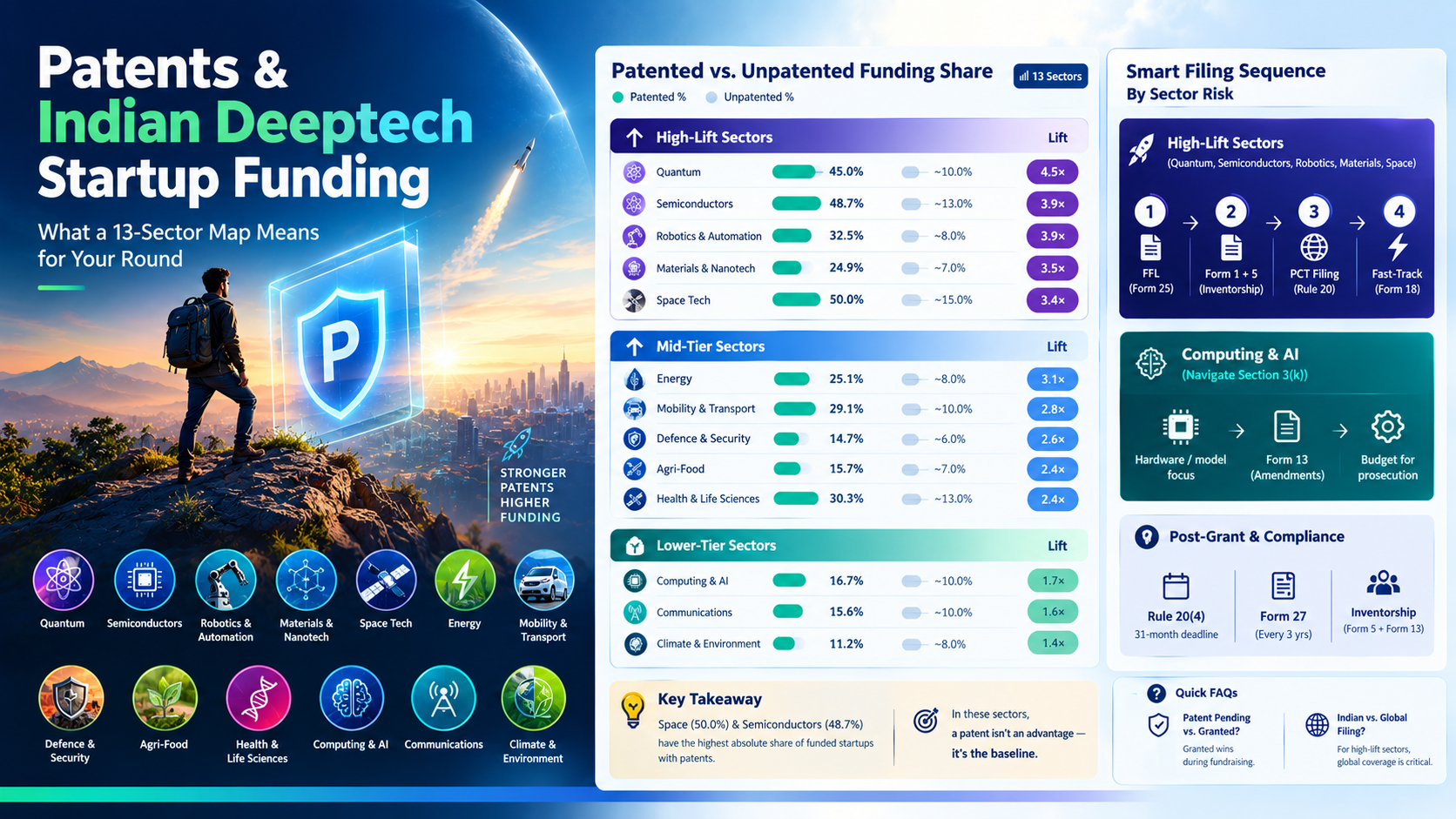
According to Arctic Invent’s Deeptech Funding Cohort Analysis, startups holding at least one patent are funded 2× to 4.5× more frequently than their unpatented peers across thirteen key sectors. In Quantum, the gap peaks at a 4.5× lift. In Climate and Environment, the lift drops to 1.4×, a variance driven primarily by grant-heavy funding structures rather than a lack of IP value.

Sector Breakdown: Lift Multipliers vs. Absolute Share

The dataset cross-references IPC/CPC patent-tagged startup rosters against Indian and global funding databases. The data reveals distinct tiers across the ecosystem:

Top-Tier High-Lift Sectors

  • Quantum: 45.0% patented share vs. ~10.0% unpatented (4.5× Lift)
  • Semiconductors: 48.7% patented share vs. ~13.0% unpatented (3.9× Lift)
  • Robotics & Automation: 32.5% patented share vs. ~8.0% unpatented (3.9× Lift)
  • Materials & Nanotech: 24.9% patented share vs. ~7.0% unpatented (3.5× Lift)
  • Space Tech: 50.0% patented share vs. ~15.0% unpatented (3.4× Lift)

Mid-Tier Sectors

  • Energy: 25.1% patented share vs. ~8.0% unpatented (3.1× Lift)
  • Mobility & Transport: 29.1% patented share vs. ~10.0% unpatented (2.8× Lift)
  • Defence & Security: 14.7% patented share vs. ~6.0% unpatented (2.6× Lift)
  • Agri-Food: 15.7% patented share vs. ~7.0% unpatented (2.4× Lift)
  • Health & Life Sciences: 30.3% patented share vs. ~13.0% unpatented (2.4× Lift)

Lower-Tier Sectors

  • Computing & AI: 16.7% patented share vs. ~10.0% unpatented (1.7× Lift)
  • Communications: 15.6% patented share vs. ~10.0% unpatented (1.6× Lift)
  • Climate & Environment: 11.2% patented share vs. ~8.0% unpatented (1.4× Lift)
Key Takeaway: Absolute funding share tells a different story than pure lift. Space (50.0%) and Semiconductors (48.7%) post the highest absolute proportion of funded startups with patents. In these categories, holding a patent is no longer a competitive advantage - it is the baseline requirement to enter institutional diligence.

Actionable Filing Sequences by Sector Risk

1. High-Lift Sequence (Quantum, Semiconductors, Robotics, Materials, Space)

When target investors include foreign strategic funds (US, EU, Japan) or domestic government procurement bodies (ISRO/IN-SPACe, MeitY, Defence RFPs), filing discipline must precede any public disclosure.

  1. Obtain Foreign Filing Licence (FFL) - Form 25 under Section 39: Mandatory for Indian-resident inventors before making any foreign application or PCT filing. Skipping Form 25 risks invalidating foreign priority claims.
  2. File Primary Application & Inventorship Declaration - Form 1 + Form 5: File Form 1 concurrently with Form 5 (Declaration as to Inventorship under Rule 13(6)). Lock down the current inventor list at the date of filing.
  3. Execute PCT International Filing - Rule 20 Frame: File the PCT international application within 12 months of the priority date to secure global coverage across target commercial jurisdictions.
  4. Request Fast-Track Examination - Form 18 / Rule 24B: File Request for Examination (Form 18) by Month 28 to maintain room ahead of the 31-month statutory ceiling.

2. Computing & AI Sequence (Navigating Section 3(k))

The lower lift in AI (1.7×) is not a sign that software IP is unvalued; it reflects high office-action rejection rates under Section 3(k) and the 2017 CRI Guidelines.

  • Focus: Draft claims strictly around hardware architecture integration, model training pipelines, or specialized runtime optimizations.
  • Prosecution: Budget for Form 13 amendment cycles under Section 57 read with Rule 81 when examiners challenge technical effect scope.

Regulatory Compliance & Post-Grant Maintenance

To avoid unexpected red flags during legal diligence, ensure your IP management accounts for key statutory requirements:

  • Rule 20(4) Cut-off vs. Condonation: The 31-month PCT national-phase entry deadline is fixed under Rule 20(4). While Rule 138 (as amended in 2024) allows discretionary Controller condonation up to 6 months via Form 4, it cannot resurrect PCT rights that have already lapsed internationally.
  • Post-Grant Working Statements (Form 27): Under Rule 131(2) (notified March 2024), Form 27 must be submitted once every 3 financial years (starting the financial year after grant), with a 6-month submission window.
  • Inventorship Amendments: Adding, removing, or correcting inventors post-filing requires a combined submission of a revised Form 5 (under Rule 13(6)) along with a petition on Form 13 (under Section 57).

Frequently Asked Questions

Is "Patent Pending" as effective as "Granted" during fundraising?

No. Granted patents provide the strongest defensive moat. Pending applications are evaluated against the file wrapper; missed Form 18 deadlines without a condonation signal operational oversight to institutional investors.

Do Indian startups need international coverage or just Indian filings?

For high-lift sectors (Semiconductors, Quantum, Space), foreign strategic leads evaluate global patentability. An Indian-only filing is structurally incomplete without international family extensions (via PCT) in key target markets.

Ready to Align Your Patent Strategy with Your Raising Strategy?

Navigating sector-specific patent requirements, foreign filing licenses, and prosecution timelines requires an IP partner that understands deeptech fundraising dynamics.

At Arctic Invent, we help deeptech founders construct defensible, diligence-ready patent portfolios designed to accelerate funding rounds.

Related Topics
Tesla’s Flying Roadster: 5 IP Lessons for Indian Innovators
Step-by-Step Guide to Semiconductor IC Layout Design Registration in India
WIPO PCT Fee Tables Effective 1 September 2026: What Changed for Indian Applicants
Step-by-Step Guide to PCT National Phase Filing for Indian Applicants
Syngenta v. Controller of Patents: How the Delhi High Court Reframed Section 3(d) for Agrochemical Polymorphs
Step-by-Step Guide to Madrid Protocol Trademark Filing for Indian Brands
Copyright Registration Cost in India (2026): A Complete Breakdown
Trademark Publication Under Section 20: Ads Spirits v. Registrar (Delhi HC, 2026)
Step-by-Step Guide to Industrial Design Registration in India (2026): Process, Validity, and Real Cost
India's Space-Tech Story Is Changing: Why GalaxEye’s US Patent Signals a Deep-Tech Revolution
Trademark Cost in India 2026
AI and Software Patentability in India in 2026: Section 3(k), the CRI Guidelines, and the Path to Grant
State-Wise IP Reimbursement Schemes in India (2026)
DPIIT Model IPR Policy for Indian Universities: NIRF Innovation Ranking Impact
Bisleri v. Kalabyraveshwara Mineral Water: Bombay HC Confirms Ex Parte Order and Disposes of Receiver's Report (2026)
Industrial Design Registration Cost in India (2026): A Complete Framework
How Indian Universities Can Earn Revenue and Build Global Reputation from Intellectual Property Lessons from Stanford, MIT, and the New DPIIT 2025 Model Guidelines
Listing a Patented API Before Launch Counts as Infringement: Incyte Holdings v. Macleods Pharmaceuticals (Delhi High Court, 27 July 2026)
Trademark Opposition Filing in India (2026): Procedure, Costs and a Sample Brief Structure
PCT National Phase Cost Comparison: India vs EPO vs USPTO vs Japan (2026)
Cost of Trademark Registration in India (2026): Official Fees, Timelines & Hidden Costs
Step-by-Step Guide to Patent Registration in India
Patent Filing Cost in India (2026): A Complete Framework
The Seismic Shift in UK AI & Software Patents: Goodbye Aerotel, Hello Duns Principles
The ₹20 Lakh Lesson: Why Filing Your Trademark Through a CA Can Ruin Your Startup Launch
CRI Guidelines 2025: What Every Indian Tech Founder Must Know About Software Patentability
CAMBA vs CAMPA: Why Changing One Letter Won't Save You From Trademark Infringement in India
Who Owns Jagannath? Inside the Trademark Battle Over a 12th-Century Deity
AI patent rejection risks in India after January 2025 ruling
Jio Platforms Enters the Global Top 20: What Its Patent Portfolio Reveals About India's Deep-Tech Ambitions
Trademark Battles Over Geographic and Generic Names: Lessons for Brand Strategy
2026 Pharma Patent Cliff: How Blockbuster Drugs Face Generic Competition & IP Challenges
Trademark Search in India: Complete Guide to IPO Database, Strategies & Infringement Prevention
Portuguese Court Rejects Louis Vuitton ‘LV’ Trademark Claim
Utility patents explained: 20-year protection for innovators
Can you trademark a viral movement? The legal risks
How Intellectual Property Rights Power Economic Development
Expired Patents and Generics: What a Landmark Ruling Means for Innovators
The High-Speed Era of AI: Navigating India's IT Rules 2026 and Global Accountability
Protecting the Persona: The Landmark Personality Rights Ruling for Aman Gupta
Zee vs Nykaa: music copyright rules in digital media
Unofficial Notepad++ for Mac risks: Brand and user safety
Taylor Swift's IP strategy: Trademarking identity against AI
India's zero-fee sports IP policy: a guide for businesses
NIL rights in the AI era: Protecting your brand
How the CSK-Sun TV copyright battle reshapes IP enforcement
Intellectual property in cloud services: risks and ownership
Naming rights in IP: Beyond just your name
Sanjay Dutt's Glenwalk Godfather whisky: A trademark dispute explained
FKA Twigs trademark lawsuit: A $1 million battle
AI Intellectual Property India: Navigating the Future
Intellectual Property: Deepfakes & AI Rules 2026
ITC Britannia Packaging War: Calcutta HC Battle Begins
Meta’s AI Afterlife Patent & the Future of Digital Identity
Top Reasons Why Design Registration is Crucial for Startups
Protecting Your Brand in India: 10 Trademark Search Strategies for 2025
The Ultimate Guide to Copyright Protection in 2025
Navigating the Murky Waters of Low-Cost Trademark Filing Platforms
Mastering Intellectual Property Strategies for Business Success
10 Reasons Why you Need an Intellectual Property Rights Consultant
Mastering Patent Search a Guide for Startups
Design Registration in India: Safeguarding Your Creative Asset
Key Differences Between Patent and Trademark Office Procedures
Design Registration Cost in India : A Complete Guide for 2025
Understanding Patentability of Algorithms Under Indian Patent Law
Startups IP Services: Accelerating Growth with Arctic Invent
Trademark Registration: Protecting Your Brand in a Competitive Market
Unlocking the Potential of IP Services in India
Unlocking Efficiency: The Power of Smart IP Solutions
The Comprehensive Guide to Patent Filing: Protecting Your Innovations
Copyright Essentials: Protecting Your Creative Works with Arctic Invent
10 Powerful IP Protection Strategies for Your Business
Trademark Registration Made Easy: Protect Your Brand
Unlock the Power of IP Services for Business Growth
Trademark Protection: Safeguarding Your Brand Identity
Understanding the Patent Act of 1970: The Foundation of Indian Patent Law
Unlocking the Benefits of Patent Registration
The Importance of a Patent Attorney: Protecting Your Innovation and Business
Filing for a Utility Patent in India: Complete Step-by-Step Guide
Your Step-by-Step Guide to Patent Registration: Protecting Your Innovations with Arctic Invent
10 Ways to Safeguard Your Innovations: A Guide to Intellectual Property Protection
Safeguarding Trust: Customer Privacy in IPR Law Firm Services
Protect Your Literary Legacy: Essential Tips for Book Copyright
Maximize Your Ideas: The Power of Patent Consulting
Protect Your Bottom Line: How IPR Law Firms Drive Cost Savings
Custom IP Services: A Startup's Secret Weapon for Competitive Advantage
Strategic IP Protection: A Startup's Guide to Safeguarding Innovation
10 Game-Changing Patents That Revolutionized Industries
Arctic Invent: Your Strategic Partner in Trademark Protection for 2025
How to Register a Patent in India
Why Patents and an IPR Law Firm Are Essential for Protecting Your Innovation
Navigating the Complex Landscape of Patent Law: A Practical Guide
Patent Data Verification: Ensure 100% Accuracy and Integrity of Your IP Data
Understanding the Patent Act: Key Considerations for Intellectual Property Protection
Copyright Consulting: Protecting Your Creative Works in the Digital Age
How to Choose the Best IP Law Firm for Your Business (2025 Guide)
10 Proven Strategies for Patent and Trademark Protection in 2025
The Ultimate Guide to Trademark Registration: Protecting Your Brand in 2025
5 Essential Steps for Strategic IP Protection Services
The Importance of Design Registration in Business

Contact Form

Thank You!

An expert will be get in touch soon
Oops! Something went wrong while submitting the form.

Patents. Trademarks. Designs.
Protected Fast, So You Innovate Faster.

Get in Touch
Subscribe To Our Newsletter
Thank you! Your submission has been received!
Oops! Something went wrong while submitting the form.