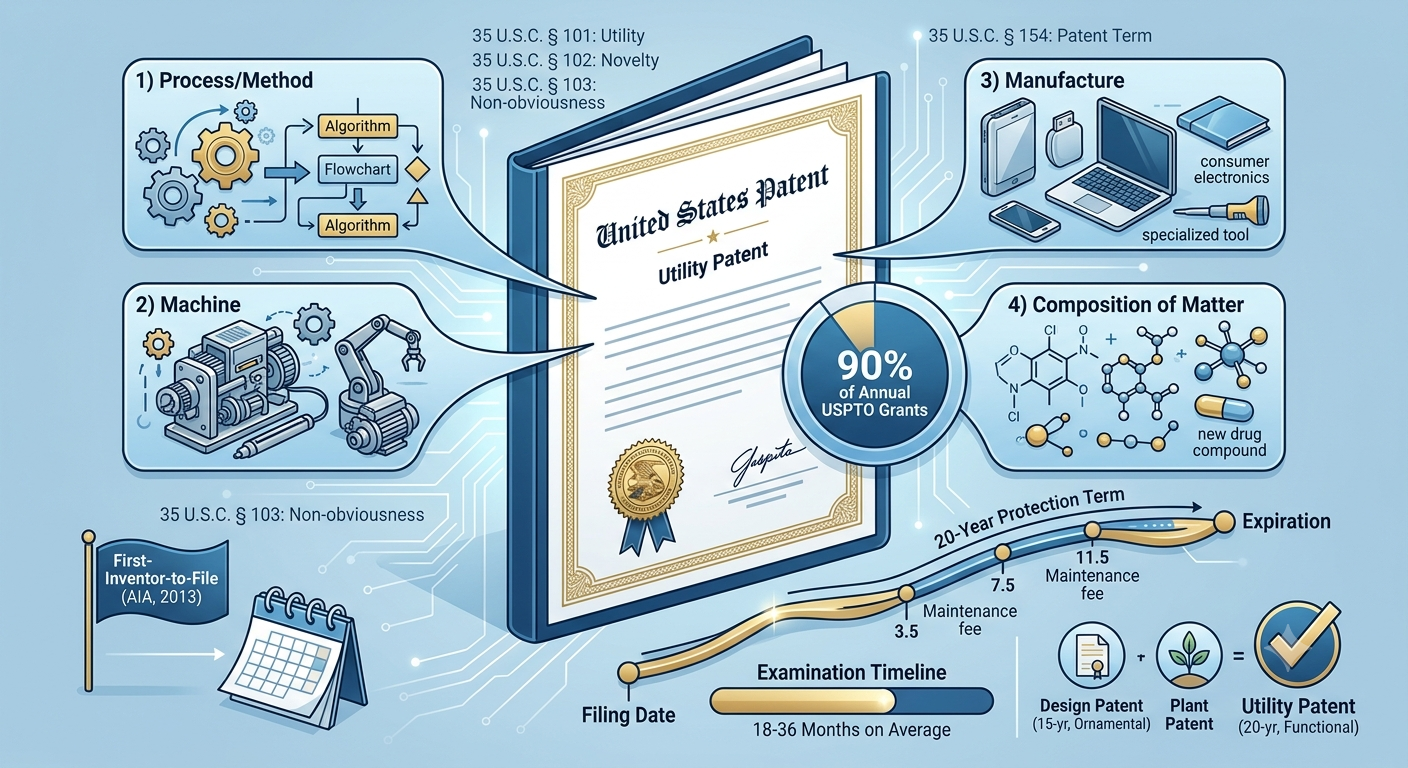
Utility patents cover 90% of the 350,000 annual USPTO grants
Utility patents represent the dominant form of intellectual property protection in the United States, accounting for approximately 90% of all patents issued by the United States Patent and Trademark Office annually. In recent years, the USPTO has granted over 350,000 patents each year, with the vast majority protecting functional inventions rather than ornamental designs or plant varieties. This overwhelming proportion reflects the central role utility patents play in protecting technological and commercial innovation across all industry sectors.
The data shows that technology fields including computer technology, digital communication, and medical technology consistently dominate application volumes. The sheer scale of utility patent filings underscores their importance as the primary mechanism for securing exclusive rights to new inventions.
Four statutory categories define the 20-year protection scope
Under 35 U.S.C. § 101, utility patents protect new and useful processes, machines, manufactures, or compositions of matter. These four statutory categories encompass virtually every type of functional invention, from software algorithms and manufacturing methods to pharmaceutical compounds and mechanical devices. The 20-year protection term begins from the filing date and requires maintenance fee payments at 3.5, 7.5, and 11.5 years to remain in force.
Legal boundaries dictate that an invention must satisfy three core requirements: novelty under 35 U.S.C. § 102, non-obviousness under § 103, and utility under § 101. Failure to meet any of these patentability criteria results in rejection during the examination process.
Examination timelines span 18 to 36 months on average
The utility patent examination process involves rigorous prior art searches, substantive evaluation of claims against patentability standards, and potential office action responses from applicants. The average examination timeline ranges from 18 to 36 months depending on the technology classification and current USPTO workload levels. Applicants must navigate this multi-stage process while responding to examiner objections and amending claims to secure allowance.
In practice, provisional patent applications provide a strategic 12-month priority period for applicants to file a non-provisional utility patent application while securing an early filing date. This mechanism allows inventors to establish patent-pending status while refining their inventions and assessing commercial viability before incurring full examination costs.
The America Invents Act established first-inventor-to-file in 2013
The America Invents Act transitioned the United States from a first-to-invent system to a first-inventor-to-file system, aligning U.S. patent law with international standards. This change took full effect in 2013 and fundamentally altered filing strategy for utility patent applicants. Early filing became absolutely critical, as the first applicant to file a patent application now receives priority rights regardless of who actually invented first.
The Patent Cooperation Treaty, administered by the World Intellectual Property Organization, facilitates international utility patent filing across more than 150 member countries. Applicants can file a single international application and subsequently enter national phase examination in selected jurisdictions, streamlining the process of securing global protection.
Patent term mechanisms extend protection beyond 20 years in specific circumstances
While the standard utility patent term is 20 years from the filing date under 35 U.S.C. § 154, patent term adjustment and patent term extension mechanisms can add time beyond this baseline. Patent term adjustment compensates for delays attributable to the USPTO during examination, while patent term extension applies to inventions subject to regulatory review periods, particularly in pharmaceutical and medical device sectors. These extensions can add several years of exclusive rights when administrative or regulatory delays reduce the effective commercial life of a patent.
Maintenance fee compliance remains essential throughout the patent term, as failure to pay required fees at the designated intervals results in automatic expiration. The USPTO does not provide grace periods beyond the six-month late payment window with additional fees, making calendar management a critical administrative function for patent holders.
Utility patents differ fundamentally from design and plant patents
The patent system recognizes three distinct types: utility patents protecting functional inventions, design patents protecting ornamental appearance for 15 years, and plant patents protecting asexually reproduced plant varieties. Each category serves a different protection purpose and follows separate examination criteria. Utility patents alone require maintenance fees and provide the longest potential protection term at 20 years from filing.
Industry standard descriptions characterize utility patents as the workhorse of the patent system, protecting functional innovations that drive technological and commercial progress. The European Patent Office conducts parallel examination functions for European utility patent applications, applying similar patentability standards under the European Patent Convention while maintaining jurisdiction-specific procedural requirements.
Legal references
35 U.S. Code § 101 (Section 101, US): This statute defines patentable subject matter, establishing that any new and useful process, machine, manufacture, or composition of matter may qualify for utility patent protection. It serves as the foundational threshold for all utility patent applications.
35 U.S. Code § 154 (Section 154, US): This provision sets the term of patent protection at 20 years from the date on which the application for the patent was filed in the United States, subject to the payment of maintenance fees. It also addresses patent term adjustments for certain delays.