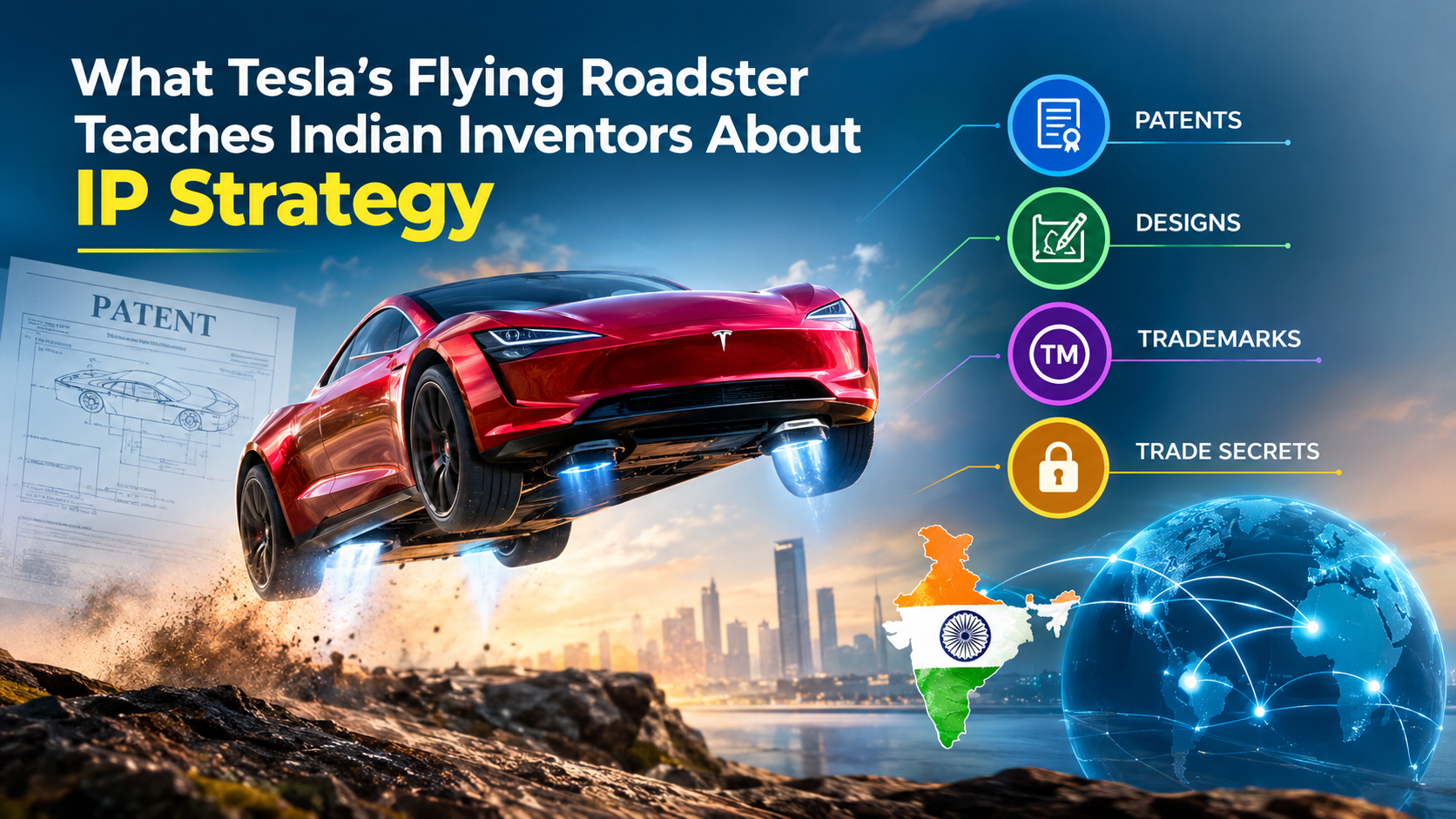
Tesla’s Flying Roadster: 5 IP Lessons for Indian Innovators
Tesla Flying Roadster: IP Lessons for Indian Startups
Introduction: Innovation Needs IP Protection
Tesla’s second-generation Roadster has attracted attention for its SpaceX-associated cold-gas thruster concept, bringing automotive and aerospace engineering into the spotlight. Production is currently planned for 2028.
Beyond the engineering spectacle, the Roadster raises an important question: Does showcasing a breakthrough technology mean a company owns exclusive rights to it?
Not necessarily. Public demonstrations, marketing claims and enforceable intellectual property rights are different things. Patent protection depends on the invention's claims, applicable law, filing history and legal status.
For Indian DeepTech founders, hardware startups and R&D leaders, the Roadster offers a useful lesson: IP protection should be considered before a product reaches the public.
1. Ferrari’s Patents Highlight the Importance of Prior Art
Ferrari has patented technologies involving aerodynamic air jets and gas-based thrust systems for vehicle dynamics.
Two relevant examples are:
- US 7,886,859 B2 — High-performance car with streamline configuration-altering air jets: View patent.
- US 11,072,381 B2 — High-performance car with gas pushers: View patent.
These documents illustrate how specific air-jet and gas-thrust technologies have been explored and protected through patents.
However, they do not establish that Ferrari patented Tesla’s exact system or that either company infringes the other’s rights. That would require a detailed comparison of patent claims, technical implementations, jurisdictions and legal status.
The lesson for Indian innovators: Never assume your technology is entirely new simply because your product looks different. A patent search can reveal existing inventions that may affect patentability or commercialisation.
2. Patent Protection Is Only One Part of an IP Strategy
A technology company does not necessarily need to patent every aspect of its product. Different IP rights protect different types of assets.
Patents can protect qualifying technical inventions that meet the applicable legal requirements.
Trade secrets can protect confidential know-how, manufacturing processes, calibration methods and other commercially valuable information, provided the necessary conditions for protection are met.
Trademarks protect brand identifiers, such as product names and logos, subject to registration and applicable law.
Industrial designs can protect eligible visual features of products, including certain shapes, configurations and ornamental elements.
The right combination depends on the technology, the ease of reverse engineering, commercial objectives and disclosure risks.
Although Tesla’s specific IP strategy for the Roadster’s thruster system should not be assumed without evidence, the broader principle applies to every technology business: build an IP portfolio around the assets that create commercial value.
3. File Before Public Disclosure
One of the biggest risks for inventors is revealing an invention before assessing its patent protection options.
A public product demonstration, technical video, conference presentation, research paper or investor pitch could disclose information relevant to patent novelty.
In India and many other jurisdictions, prior public disclosure can jeopardise patentability, subject to applicable statutory exceptions. Grace periods and exceptions differ between countries, so founders seeking international protection should not assume that a disclosure will be excused everywhere.
What should Indian founders know?
In India:
- Form 1 is the application for grant of a patent.
- Form 2 contains the provisional or complete specification.
- A provisional specification must adequately describe the invention it is intended to support.
- The complete specification generally needs to be filed within 12 months of the provisional filing to continue the application.
A provisional filing does not automatically protect every feature developed later. Priority depends on whether the relevant subject matter was adequately disclosed in the earlier specification.
Best practice: Document the invention, assess its patentability and plan the filing before a public launch wherever possible.
4. Protect Product Appearance and Brand Identity
Technical inventions are not the only valuable assets a startup may need to protect.
Industrial design registration
For eligible vehicle designs, Locarno Class 12-08 covers motor cars, buses and lorries.
Under the Paris Convention, the general priority period for qualifying industrial design applications is six months from the first filing when seeking corresponding protection in other Convention countries. This is an international priority period—not a universal deadline for filing an initial design application.
Founders should assess design eligibility and filing timelines before publishing detailed product images or exhibiting prototypes.
Trademark registration
Depending on the business model, relevant trademark classes may include:
ClassPotential coverage12Vehicles and relevant vehicle goods9Electronics and eligible software products37Repair and maintenance services42Software development, SaaS and technology services
The correct classes depend on the actual goods and services offered. Not every startup needs to register in all four.
A well-planned trademark portfolio can help protect brand identity as the company expands into new products and markets.
5. Check Section 39 Before Filing Patents Abroad
Indian residents planning international patent protection must consider Section 39 of the Patents Act, 1970.
The provision regulates foreign patent applications by persons resident in India. Depending on the circumstances, applicants may need prior permission from the Indian Patent Office or may follow the statutory route involving an earlier Indian filing and compliance with the prescribed conditions.
Form 25 is used to request permission for making a patent application outside India under the applicable procedure.
The route available depends on factors such as residency, the filing history of the invention and any applicable secrecy directions. Founders should not assume that an overseas filing can proceed without checking these requirements.
International filing strategy should be coordinated with the invention's priority dates, target markets and commercial plans.
Bonus Lesson: Patentability Is Not Freedom to Operate
Obtaining a patent does not automatically mean a company can commercialise its product without infringing someone else's patent.
A patentability search investigates whether an invention may qualify for patent protection.
A freedom-to-operate (FTO) analysis examines whether a proposed product or process may fall within enforceable third-party patent claims in the relevant markets.
For hardware and DeepTech startups, this distinction is important. A company may develop a patentable improvement while still needing to address third-party patent rights covering parts of the underlying technology.
Conclusion: Build the Technology. Protect the Invention. Plan the Reveal.
Tesla’s Roadster and Ferrari’s patent documents offer a useful starting point for understanding the relationship between engineering innovation and intellectual property.
But neither public attention nor a patent title establishes the full legal position. Innovators must examine the actual technology, patent claims, filing history and applicable law.
For Indian startups, the priorities are clear:
- Search the existing patent landscape.
- Assess patentability before disclosure.
- Consider patents, trade secrets, designs and trademarks together.
- Evaluate freedom to operate before major commercial commitments.
- Check Section 39 before filing patents abroad.
Your next product launch should not be the first time you think about IP protection.
Arctic Invent helps businesses explore patent searches, patent drafting, freedom-to-operate analysis and broader IP strategy to make informed decisions about protecting and commercialising innovation.
Disclaimer: This article is for general informational purposes only and does not constitute legal advice. Patentability, infringement, design eligibility and foreign-filing requirements depend on the specific facts and applicable law.
Frequently Asked Questions
1. Did Ferrari patent Tesla’s Flying Roadster technology?
Ferrari has patents involving aerodynamic air jets and gas pushers, but the cited documents do not establish that Ferrari patented Tesla’s exact system or that infringement has occurred.
2. Should startups file patents before product launches?
Generally, yes, if patent protection is being considered. Public disclosure may affect novelty, and international rules vary.
3. What is Section 39 of the Indian Patents Act?
It regulates foreign patent applications by persons resident in India and may require prior permission or compliance with a specified statutory route.
4. Why do startups need an FTO analysis?
An FTO analysis helps assess potential conflicts with enforceable third-party patent claims before commercialising a product in a particular market.