Step-by-Step Guide to Industrial Design Registration in India (2026): Process, Validity, and Real Cost
Step-by-Step Guide to Industrial Design Registration in India (2026): Process, Validity, and Real Cost
Most "design registration cost India" guides copy the patent 80% rebate wording and ship it. That is structurally wrong. Design fees live under the First Schedule of the Designs Rules, 2001 (as periodically amended), and the rebate math is its own different from the Patent Form 1 tier and different from the Trade Marks Act Schedule I/II tiers. The fee you actually pay depends on (a) which Designs Form you file, (b) whether you fall in the natural-person / small-entity / DPIIT-startup tier or the "others" tier, and (c) whether your application covers a single design or a set of articles of the same general character under a single Locarno class. Get those three things right and the cost becomes deterministic. Get them wrong and you either under-quote your client or over-charge and lose the bid.
This guide walks through what a designer, a startup product manager, or a tier-3 enterprise IP counsel actually experiences when filing under the Designs Act, 2000 in 2026 the Forms, the Section 4 novelty bar, the Section 21 / Rule 28 / Form 11 exhibition carve-out (with its 6-month filing follow-up), the Section 19 / Form 8 third-party cancellation mechanism, and the fee-bearing movements: filing, registration, post-registration cancellation defence, and restoration.
What "Industrial Design" Means Under the Designs Act, 2000
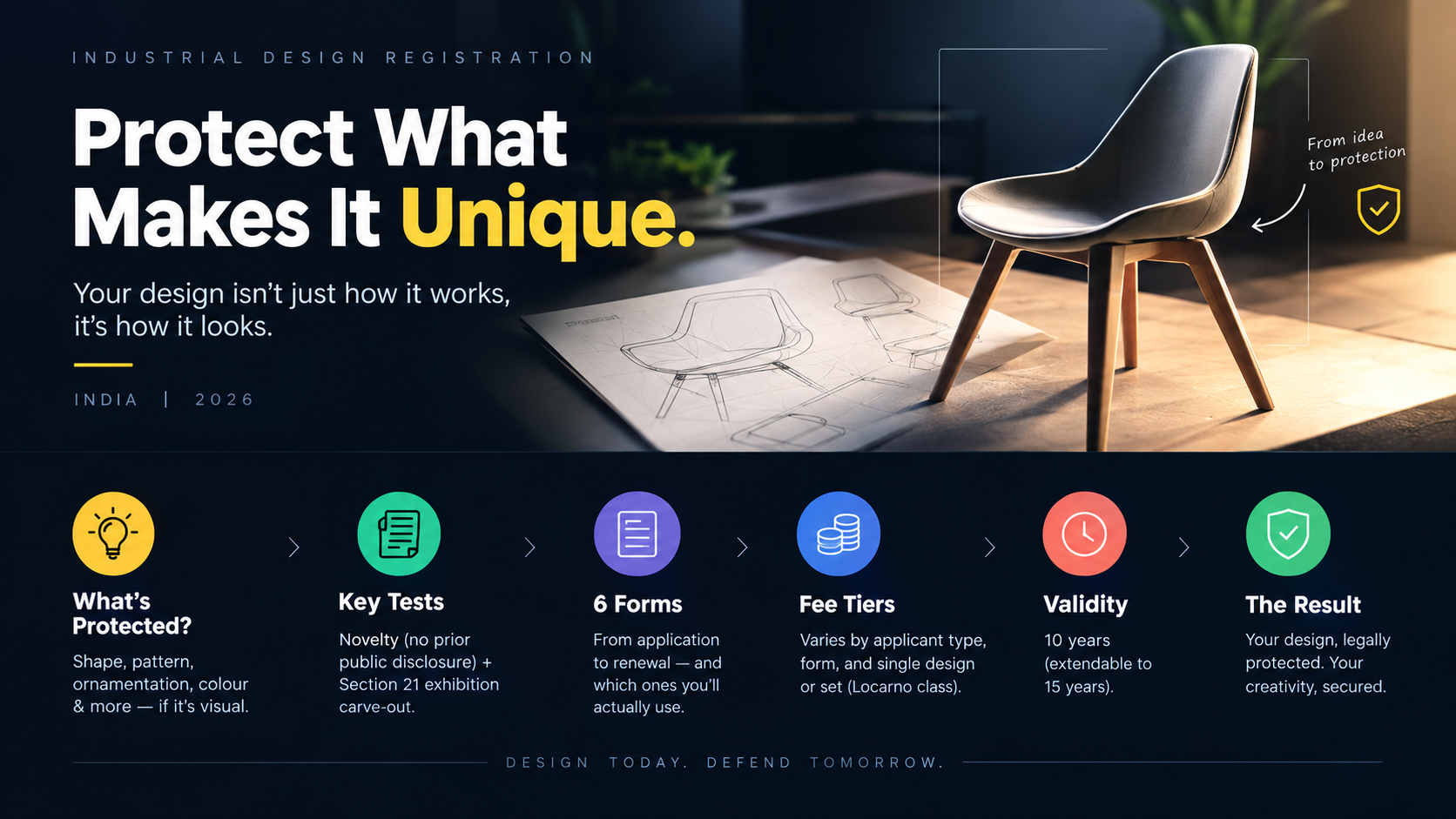
An industrial design is the visual features of shape, configuration, surface pattern, ornamentation, or composition of lines or colours applied to an article, judged solely by the eye. That one-sentence statutory definition does most of the legal work and it directly excludes anything functional, mechanical, or dictated solely by utility. A grip that "looks ergonomic" only registers if it has a visual identity separable from the ergonomic function.
The regime sits in the Designs Act, 2000 read with the Designs Rules, 2001 as amended. The Designs Registry has its head office in Delhi with regional branches at Kolkata, Mumbai, Chennai, and Ahmedabad. The Act has its own substantive tests, its own Forms (1–11), its own First Schedule of fees, its own novelty framework, and its own cancellation route. It does not borrow from the Patents Act, 1970, the Trade Marks Act, 1999, or the Copyright Act, 1957. Any guide that quietly borrows is wrong.
Two Statutory Tests That Decide Whether You Register
The novelty test under Section 4 is the strictest bar in Indian IP law there is no general grace period for prior public disclosure. If your design has been published anywhere in India or anywhere else in the world before your filing date, it has lost novelty and is dead-on-arrival. This is dramatically stricter than copyright (which protects original expression automatically) and stricter than trademarks (which protect first-to-use goodwill). Designers used to copyright's leniency frequently forfeit design novelty by posting product photos on Instagram before filing.
The single carve-out is Section 21 of the Designs Act, 2000 read with Rule 28 of the Designs Rules, 2001 and Form 11 (notice of exhibition) and it is narrower than most guides describe. Merely filing Form 11 before an officially notified exhibition is not in itself enough. Section 21 requires that the applicant must also file the complete Form 1 application within six months from the date of the first exhibition of the design for the carve-out to preserve novelty. Designers who file Form 11 but then delay the Form 1 beyond six months lose the carve-out entirely, and the design is killed by its own exhibition. Plan the filing calendar around the launch calendar, not the other way round.
The Six Forms You'll Actually Use (And The Five You'll Never Touch)
Forms are not interchangeable across IP regimes. A common error in published guides is to import Form labels from Patents (Form 1, Form 5, Form 18) into a Design post they are different forms, with different First Schedules, with different fee tiers. The lifecycle hits six:
Form 1 (Application for registration of a design) under Section 5 this is the substantive filing. One design per Form 1. Multiple designs across the portfolio require multiple Form 1 applications. Where the application claims a Paris Convention priority date under Section 14, that priority claim is filed inside Form 1 itself by ticking the reciprocal-arrangement box and attaching the priority document; it is not a separate form.
Form 2 (Claim to proceed as applicant / joint applicant) under Rule 15 used for transfer or succession-in-title filings. Form 2 is not a Paris priority claim and not an amendment form.
Form 3 (Application for renewal of copyright in a registered design) under Section 17(2) read with Rule 25 of the Designs Rules, 2001 filed at the 10-year mark to extend protection from 10 to 15 years. This is the design-regime's renewal / extension form, distinct from the Patent Form 21 (compulsory licence termination) and distinct from the Trade Marks TM-R.
Form 4 (Application for restoration of a lapsed design) under Section 11 used when the renewal fees were missed at year-ten and protection has lapsed. Filed within the statutory restoration window under Section 11 of the Designs Act, 2000.
Form 5 (Application for permission to inspect the register / to obtain a certifiable copy of an entry) the register-inspection and certified-copy mechanism. Form 5 is not a cancellation form and not a restoration form. Conflating the three is among the most common errors in published cost guides.
Form 8 (Application for cancellation of a registered design) under Section 19 filed by third parties against your mark on grounds including Section 4 prior publication or Section 9 invalidity. Critically, the Indian Designs Act has no pre-registration opposition window and no post-publication opposition window unlike the Trade Marks Act's Section 20/21 opposition route. Form 8 under Section 19 can be filed by an interested person at any time after registration, before the Controller.
The Step-by-Step Filing Path
A Design filing is shorter than a Patent or Trademark prosecution, but every step is unforgiving of timing. The path:
Step 1 — Clearance search. Run a same-Locarno-class prior-art search against the published Designs Register on ipindiaonline.gov.in. Confirm freedom-to-operate before paying official fees. Online search of the published register is free; agent-led accelerated search is fee-bearing.
Step 2 — Representation sheets. Standard set is seven views (front, back, top, bottom, left, right, and a perspective view). For a set of articles of the same general character within a single Locarno class, a separate representation set per article is required, but the application carries a single Form 1 and a single fee.
Step 3 — File Form 1 with the Designs Registry. Online filing through the IPO e-filing portal is the default. You'll pay the Form 1 First Schedule fee tier depending on natural-person / small-entity / DPIIT-startup versus "others", multiplied per Locarno class. Examination under Section 5 is automatic upon filing Form 1 and paying the official fee — there is no separate "Request for Examination" Form (unlike Patent Form 18 under Rule 24B). Don't quote clients an exam-request fee line; the exam is part of the same Form 1 process.
Step 4 — Examination under Section 5. The Examiner tests novelty (Section 4), originality (Section 6), registrability (Section 9), and non-functionality. Any objection surfaces in an Examination Report and is responded to within the prescribed period.
Step 5 — Registration and publication in the Designs Journal. If accepted, the design is registered under Section 7 and published in the Designs Journal. Unlike trademarks, there is no opposition window after journal publication under the Indian Designs Act — no third-party "TM-O-style" pre-registration opposition mechanism. Third parties who want to challenge the design post-registration file Form 8 under Section 19 with the Controller at any time during the design's 10-year life (or 15-year if renewed).
Step 6 — Renewal at the 10-year mark to extend to 15 years on Form 3 under Section 17(2) of the Designs Act, 2000, filed before the year-ten anniversary. The First Schedule renewal fee applies.
Step 7 — Restoration, if the renewal lapsed. Filed on Form 4 under Section 11 within the statutory restoration window. Past that window, the design is permanently in the public domain.
The Three Cost Tiers You'll Encounter
Tier 1 — Filing and first-stage examination (Years 0–1). Includes Form 1 filing fee per design per Locarno class, representation-sheet preparation, drawings compliance, the agent's first-stage professional charges, and Form 11 if you are filing an exhibition notice at an officially notified event.
Tier 2 — Post-registration (Years 1–10 if uncontested). Includes watch-service monitoring of the published Designs Journal, response-to-cancellation costs if a third party files Form 8, and Section 15(2) Copyright Act overlap issues if a freelance designer originally drew the representation sheets.
Tier 3 — Renewal to 15 years and any restoration (Years 10–15+). Form 3 renewal fee under the First Schedule, plus Form 4 restoration fees if you let year 10 lapse.
Three Realistic Cost Scenarios (No Flat Tables, No Fabricated Figures)
Scenario A — Solo designer, 1 design, 1 Locarno class. Founder of a lifestyle-product brand files one design. The First Schedule natural-person / small-entity / DPIIT tier official fee + agent professional charges (representation sheets, Form 1, novelty search). Total realistic range: a few hundred to a couple thousand INR in government fees plus the agent fee. Lowest absolute tier; also the regime where the Section 4 Instagram-disclosure trap is hit most often.
Scenario B — D2C startup, 5–10 designs across 3–4 Locarno classes. Consumer-products startup filing a portfolio across product lines. Each design = its own Form 1, each class = its own tier. Government fees scale linearly by design and by class. This is where the "one Form 1 per design" error is most often committed — bundling five designs on one Form 1 fails at examination because Form 1 is structurally one design per application, possibly with a set of articles of the same general character within a single Locarno class.
Scenario C — Enterprise product portfolio, 25+ designs, multi-jurisdictional. Tier-3 enterprise IP counsel files a coordinated portfolio, usually coordinating Indian filings with Paris Convention routes. Each Indian design is its own Form 1; Paris Convention priority is claimed inside Form 1, not via Form 2. Agent fees are negotiated retainers. Note: India is not currently a contracting party to the WIPO Hague System for international designs — international design protection for Indian applicants must be built through national filings and Paris Convention routes, not Hague.
Hidden Costs and Traps
The Section 4 trap. Social-media launch announcements, Kickstarter previews, retailer showroom reveals, conference demos, beta-test samples to journalists — any of these destroy novelty. Form 11 under Section 21 and Rule 28 only protects disclosure at an officially notified exhibition, and only if Form 1 is also filed within six months of the first exhibiting. Merely filing Form 11 alone is not enough.
The "one design per Form 1" error. Trying to bundle multiple designs on a single Form 1 across separate product lines is rejected at examination. Form 1 is structurally one design, optionally extended to a set of articles of the same general character within a single Locarno class.
Confusing the renewal form across regimes. Form 3 under Section 17(2) of the Designs Act, 2000 is the design-regime's renewal / extension mechanism that extends protection to 15 years. It is not the Patent Form 21 (compulsory licence termination under Section 94 read with Rule 102) and not the Trade Marks TM-R. Each regime has its own renewal form label.
The Section 15(2) Copyright overlap. If a freelance designer drew your representations or originated the visual design as an "artistic work" under the Copyright Act, 1957, that artistic work carries its own copyright — but §15(2) of the Copyright Act limits copyright in a design capable of registration under the Designs Act to artistic-work-equivalent protection only up to the point at which the article is reproduced more than fifty times by an industrial process. Beyond that threshold, ongoing protection comes from the Designs Act registration, not from copyright. Plan for a written author-assignment or commissioning agreement that explicitly addresses the §15(2) boundary; otherwise the original creator's copyright could be asserted as a secondary right in infringement disputes.
The "I thought Design was like Trademark" error. New IP counsel often default to opposition-window thinking modelled on the Trademark Act's Section 20/21 framework. The Indian Designs Act has no opposition window — neither pre-registration nor post-publication. If a third party wants to challenge the design, they file Form 8 under Section 19 with the Controller at any time during the design's life. This is structurally distinct from any opposition regime.
When to File a Design vs. a Patent vs. a Trademark vs. a Copyright
Design, Patent, Trademark, and Copyright overlap — and the §15(2) copyright layer explicitly funnels designs into the Designs Act. A design covers the visual appearance of an article. A patent covers a functional invention (the working mechanism). A trademark covers source-identifying marks. A copyright covers original literary, dramatic, musical, or artistic works — including a design's underlying artistic work, but §15(2) pushes that copyright protection into a 50-reproduction industrial cap.
The four can coexist on a single product: a smart-bottle design (registered as a Design), its novel insulation method (filed as a Patent), the brand name (filed as a Trademark), and the original artist's drawing (an assignable copyright until §15(2) takes over at the 50-reproduction industrial-process threshold).
The choice is governed by what you want to enforce against. Design infringement suits under Section 22 test whether a defendant has copied the visual features. Patent suits under Section 104 test function and equivalents. Trademark suits under Section 29 test confusion. Copyright suits (before the section 15(2) threshold) test copying of the artistic work. Don't conflate them.
Frequently Asked Questions About Industrial Design Registration in India (2026)
How long does a Design registration take in India?
Filing to initial examination typically runs 6–12 months at the Designs Registry. From acceptance to journal publication is usually a few weeks. From publication to a final registered certificate is typically another 6–18 months. The prosecution timeline is shorter than a Patent application, and the official fees are also lower, which is why the regime is so heavily used by product-led startups.
How long does protection last?
Ten years from the filing date, extendable to fifteen by filing Form 3 under Section 17(2) of the Designs Act, 2000 before the year-ten anniversary. No annual annuities between filing and year 10; a single renewal checkpoint at year 10 to extend protection to year 15. After year 15, the design enters the public domain.
What if a third party challenges my design after registration?
Third parties challenge via Form 8 under Section 19 of the Designs Act, 2000 on grounds including prior publication under Section 4, lack of originality, or invalidity under Section 9. There is no opposition window — Form 8 can be filed at any time after registration, before the Controller, while the design remains in force. You file a counter-statement, evidence, and attend hearing. Cancellation can revoke your registration retroactively if prior publication is proven. If your only prior public exposure was an officially notified exhibition with Form 11 filed and Form 1 filed within six months, this is your defensible position.
Can I file a Design application myself, or do I need a registered patent agent?
The Designs Registry accepts applications from individual applicants directly. However, Section 41 read with Rule 67 require that an applicant not established in India must file through a registered agent or attorney resident in India with a service address in Indian jurisdiction. Indian-resident applicants can file directly; foreign applicants without an Indian service address must engage an Indian registered patent agent for filing and correspondence.
Can I file multiple designs in a single Form 1 application?
No. Form 1 covers one design applied to one article, or to a set of articles of the same general character within a single Locarno class. Multiple designs across separate product lines or separate Locarno classes require separate Form 1 applications. The First Schedule fee scales per design per class.
Does Indian Design registration give me worldwide protection?
No. A Design registration is territorial. Indian registration protects against infringement in India. International protection requires either national filings in each target country, a Paris Convention priority claim filed inside Form 1 within six months of the Indian filing date, or — for jurisdictions covered by other centralised routes — bilateral treaties where applicable. India is not currently a contracting party to the WIPO Hague System for International Registration of Industrial Designs, as confirmed by the WIPO Hague contracting-parties list; Indian applicants cannot use Hague as a single-filing entry point.
What happens if I miss the renewal deadline at year 10?
The design lapses. You can restore it by filing Form 4 (Application for Restoration) under Section 11 of the Designs Act, 2000 within the statutory restoration window prescribed by the Designs Rules, 2001 as amended. Past that window, the design is permanently in the public domain.
What is the relationship between Design copyright and Copyright Act protection?
Copyright Act, 1957 protects original artistic works. Section 15(2) of the Copyright Act, 1957 limits copyright protection in a design capable of registration under the Designs Act once the article is reproduced more than fifty times by an industrial process — beyond that, ongoing protection comes from the Designs Act (assuming you have a registration), not from copyright. In practice, a freelance illustrator's drawing carries copyright only as an artistic work up to the §15(2) threshold; after that threshold, the designer of the industrial article must rely on Designs Act registration for continuing enforcement.
Can a design be licensed or assigned?
Yes, through registered assignment or licensing with the Designs Registry under Section 20 read with Rule 29. License and assignment documents should be filed for record; unrecorded licenses do not bind third-party purchasers.
Key Terms Explained
Designs Act, 2000 — substantive statute governing industrial design registration in India, read with the Designs Rules, 2001 as amended.
Designs Rules, 2001 — procedural Rules and the First Schedule of government fees. First Schedule tiers for Designs are distinct from Patent Rule tiers and from Trade Marks Act Schedule I/II. Always verify fee figures against the current Rules before quoting.
Section 4 — prior-disclosure novelty bar. A design published anywhere before filing is not registrable. Strict bar, with one narrow carve-out.
Section 21 read with Rule 28 and Form 11 — the only statutory carve-out from Section 4. Notice of exhibition at a Controller-notified event, filed pre-event. Critically, the carve-out only holds if Form 1 is filed within six months of the first exhibition.
Section 17(2) — the renewal / extension provision. Allows the proprietor to extend registration from 10 to 15 years before expiry of the initial 10-year term through Form 3.
Section 11 — restoration provision. A lapsed design (one whose renewal fees were missed) can be restored within the statutory window through Form 4.
Section 19 — cancellation provision. Third parties can file Form 8 at any time while the design is in force. There is no opposition window at any stage.
Form 1 — substantive filing form under Section 5. One design per Form 1, optionally extending to a set of articles of the same general character in one Locarno class.
Form 2 — successor-in-title / claim to proceed as applicant (transfer route). Not a priority claim (priority is filed inside Form 1).
Form 3 — design renewal / extension form under Section 17(2), filed before the year-ten anniversary to extend protection to 15 years. Distinct from Patent Form 21 and from Trade Marks TM-R.
Form 4 — design restoration form under Section 11, filed within the statutory restoration window after lapse.
Form 5 — register-inspection / certified-copy request. Not the restoration form and not the cancellation form.
Form 8 — design cancellation form under Section 19, filed by third parties at any time during the design's life. There is no opposition window.
Section 15(2) of the Copyright Act, 1957 — limits copyright in a design capable of registration under the Designs Act to artistic-work protection only up to fifty industrial-process reproductions; past that, ongoing protection must come from a Designs Act registration.
Locarno Classification — the international industrial-design classification system. India uses it for class-based fee calculation; multi-class filings multiply base fees.
Paris Convention priority — six-month deadline from Indian filing for reciprocal priority claims in Paris Union countries. Claimed inside Form 1.
Hague System / WIPO Hague — International Registration of Industrial Designs administered by WIPO. India is not currently a contracting party.