Step-by-Step Guide to PCT National Phase Filing for Indian Applicants
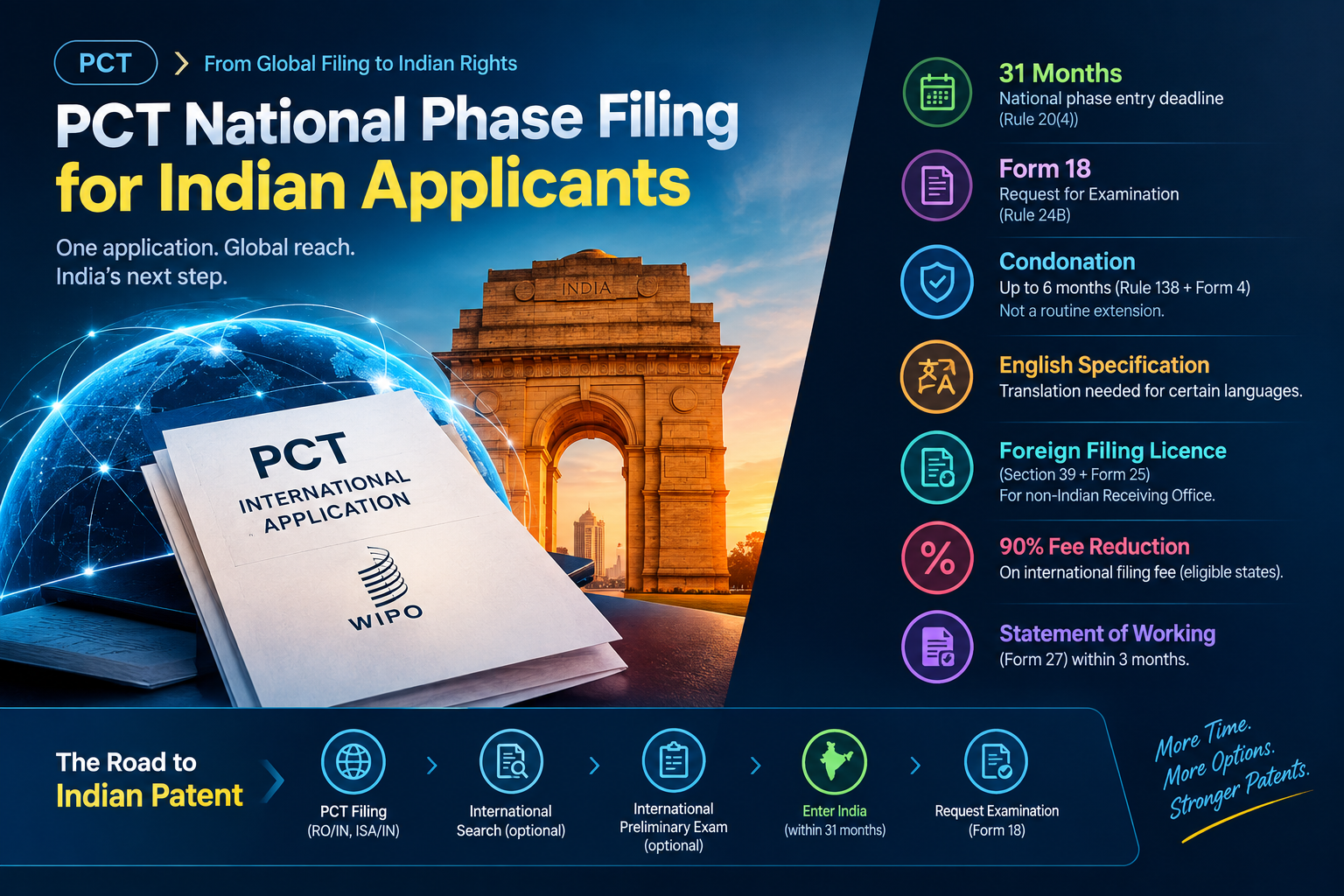
An Indian applicant with a published PCT international application enters the Indian national phase within the 31-month deadline fixed by Rule 20(4) of the Patents Rules, 2003 (this deadline has been part of the Patents Rules, 2003 since enactment and was not affected by the 2024 amendment, which substituted Rules 24B, 131 and 138 but did not touch Rule 20(4) itself). Request for Examination follows separately on Form 18 under Rule 24B of the Patents Rules, 2003 as substituted by the Patents (Amendment) Rules, 2024 notified 15 March 2024. Condonation of delay is available under amended Rule 138 read with Form 4 applicants should not rely on Rule 138 as a routine mechanism to delay the Rule 20(4) 31-month national phase entry deadline, because condonation interacts in a complex way with international PCT treaty timelines under Articles 22 and 39, and absent Rule 138 condonation, Form 18 filed outside Rule 24B results in the application being treated as withdrawn by the applicant under Section 11B(4) of the Patents Act, 1970.
This guide is for Indian inventors, in-house IP counsel at DPIIT-recognised startups and MSMEs, academic researchers commercialising campus inventions, and registered Indian patent attorneys converting a published PCT application into a live Indian patent application. India acceded to the PCT on 7 December 1998. The Indian Patent Office acts as Receiving Office (RO/IN), as one of seventeen International Searching Authorities (ISA/IN), and as a designated/elected Office for national phase entry.
What is the PCT and Why Does It Matter for Indian Applicants?
The Patent Cooperation Treaty (PCT) is the international patent filing treaty administered by WIPO in Geneva. It does not grant a "world patent". It consolidates a single international application into a streamlined procedure for formal filing, optional international search, optional international preliminary examination, and subsequent national phase entry in any of the more than 150 contracting states (as of 1 September 2026 WIPO PCT Fee Tables) including India, the United States (USPTO), the European Patent Office, Japan, China, South Korea, and the United Kingdom.
For Indian applicants, the PCT's structural benefit is the priority-date extension: the international application reserves the priority date and gives the applicant 31 months (under India's Article 22(1) declaration) before national-phase filing is locked in under Rule 20(4) of the Patents Rules, 2003. This differs materially from the Paris Convention 12-month window. Indian applicants whose commercial footprint requires patent protection in 3 or more PCT contracting states use the PCT to buy additional time for scope, translation, jurisdiction-cost budgeting, and capital raising before committing national filing fees in each country.
Key Features of PCT National Phase Filing in India
- 31-month national-phase entry deadline from the priority date fixed by Rule 20(4) of the Patents Rules, 2003. The 31-month cutoff has been part of the Patents Rules, 2003 since enactment and was not modified by the Patents (Amendment) Rules, 2024 notified 15 March 2024.
- Form 18 — Request for Examination is governed separately by Rule 24B of the Patents Rules, 2003 as substituted by the Patents (Amendment) Rules, 2024; Form 18 initiates examination under Section 11B and carries its own (Rule 24B-internal) condonation interaction with PCT timelines.
- Condonation under amended Rule 138 read with Form 4 — the Controller has broad discretionary power to condone delays for up to six months on payment of the prescribed Form 4 fee, but this is a discretionary remedy, not a routine extension of the statutory 31-month window. In particular, amended Rule 138 condonation should not be relied on as a buffer for the Rule 20(4) 31-month national phase entry deadline itself: the condonation interacts with international PCT treaty timelines under Articles 22 and 39 in a complex way, and Rule 138 may not resurrect substantive PCT treaty rights that have already lapsed internationally.
- Without Rule 138 condonation, Form 18 filed outside Rule 24B results in the application being treated as withdrawn by the applicant under Section 11B(4) of the Patents Act, 1970. The pre-grant opposition term "deemed abandoned" applies to Section 21(1) contexts, not to Section 11B(4).
- English specification required — translation required where the PCT is in French, German, Japanese, Chinese, Korean, Spanish, Russian, Arabic, or Portuguese.
- Foreign Filing Licence required under Section 39 of the Patents Act, 1970 read with Form 25 for any PCT international filing through a non-Indian Receiving Office. The Section 39 six-week rule operates independently of PCT timings.
- 90% reduction on the international filing fee under PCT Schedule of Fees footnotes 2 and 14 for applicants from eligible States (India is among these) — applied to the international filing fee, per-sheet-over-30 fee, supplementary search handling fee, and handling fee.
- Statement of Working (Form 27) under Rule 131(2) of the Patents Rules, 2003 as substituted by the Patents (Amendment) Rules, 2024 notified 15 March 2024: Form 27 is now filed for a 3-financial-year block, starting from the financial year commencing immediately after the year of grant, and must be submitted within 6 months following the end of each 3-financial-year period.
Who Can File PCT National Phase in India?
The same applicant as named in the PCT international application (or a recorded ownership transfer via PCT assignment at WIPO before national-phase entry, or Form 13 at IP India). Eligible applicants include individual Indian nationals, partnerships, LLPs, private limited companies, DPIIT-recognised startups, MSMEs, foreign applicants with a real and effective industrial or commercial establishment in India, and NRIs with India-domiciled inventors eligible under Section 3 of the Patents Act, 1970. Where the PCT was filed at a non-Indian Receiving Office, an Indian-resident applicant must first obtain an FFL on Form 25 under Section 39 regardless of whether the national-phase filing eventually enters India.
Step-by-Step PCT National Phase Procedure from India
- Confirm the PCT international application is published and the priority date is secured publication occurs 18 months after priority under PCT Article 21, producing a WO number; the Rule 20(4) 31-month deadline runs from the priority date, not the WO publication date.
- Retrieve the PCT international application copy, ISR, and any IPRP via WIPO PATENTSCOPE at wipo.int/patentscope or directly from the Receiving Office (ISR from ISA/IN routinely, plus EPO, JPO, USPTO, KIPO, CNIPA; IPRP Chapter I or Chapter II optional under PCT Articles 18 / 36).
- Prepare the Indian national-phase application package: Form 1 (application for patent with inventor declarations), Form 5 (declaration of inventorship under Rule 13(6)), the complete specification in English (translation mandatory if the PCT is in a non-English language), IP India-format drawings from the PCT-certified copies, sequence listings where required for biotech inventions, and the PCT international application number, international filing date, and priority data.
- File the national-phase application before the Rule 20(4) 31-month deadline electronic filing via IP India e-filing where possible, paying the Indian national-phase fee tier per the Patents Rules, 2003 First Schedule (as amended): small entity / startup / natural person / educational institution tier versus "others" tier. Treat the Rule 20(4) 31-month deadline as hard-edged and do not rely on Rule 138 condonation as a routine buffer on this primary deadline.
- File Form 18 (Request for Examination) under Section 11B read with Rule 24B distinct from Form 9 (early publication under Rule 24A). Late Form 18 filing can be condoned under Rule 138 read with Form 4 if the Controller, in discretion, accepts the condonation request; condonation is not automatic. Absent Rule 138 condonation, the application is treated as withdrawn under Section 11B(4) of the Patents Act, 1970.
- Prosecution begins at the Indian Patent Office First Examination Report (FER) with potential objections under Section 3 (Section 3(d) for known substances, Section 3(k) for computer-related inventions, Section 3(i) for agricultural methods, Section 3(b) for public order) or Section 2(1)(ja) novelty and inventive step. Section 3(k) is anchored to the CRI Guidelines 2017 read with the Patents (Amendment) Rules 2024 Section 3(k) practice.
PCT National Phase Fees from India
Fees split into three blocks: WIPO PCT international-phase fees, Indian Receiving Office (RO/IN) fees for filing at the Indian Patent Office, and Indian national-phase fees on entry under Rule 20(4). Always verify all figures against the current WIPO PCT Fee Tables and the IP India First Schedule at the time of filing both are updated periodically.
- WIPO PCT International Filing Fee: in Swiss francs (CHF) per the WIPO PCT Fee Tables.
- WIPO PCT fee per sheet over 30: small additional CHF fee per page beyond 30.
- WIPO PCT electronic-filing reductions: up to CHF 100, CHF 200, or CHF 300 per PCT Schedule of Fees Items 4(a), 4(b), 4(c) when filed in the prescribed electronic form.
- 90% reduction for applicants from eligible States (India) under footnotes 2 and 14 of the PCT Schedule of Fees applied to the international filing fee, fee per sheet over 30, supplementary search handling fee, and handling fee, with exemption from the WIPO International Bureau transmittal fee.
- Indian Receiving Office (RO/IN) transmittal fee: paper filings attract a reduced tier for natural persons, startups, small entities and educational institutions versus a higher tier for others; e-filing through IP India is exempt from this fee.
- Indian search fee (ISA/IN): when ISA/IN is selected Indian natural-person / startup / small entity / educational institution tier is the lower of the two RO/IN tariffs.
- Indian non-ISA/IN ISR fee: equivalent fee structure at the higher end of the ISAs used by Indian applicants.
- Indian national-phase entry fee: tier-differentiated per the Patents Rules, 2003 First Schedule (as amended).
- Form 18 fee: tier-differentiated under Rule 24B read with the Patents Rules First Schedule (as substituted by the 2024 Amendment Rules).
- Form 4 fee (Rule 138 condonation): prescribed fee under the Patents Rules, 2003 First Schedule (as substituted by the 2024 Amendment Rules) for condonation requests.
- Indian patent attorney fees: PCT filing coordination, Form 1 / Form 5 prosecution, English-translation coordination, FER response drafting under Section 3(d) / 3(k), and post-grant annuity management under Rule 80.
Validity, Renewal, Statement of Working, and What Cannot Be Filed
The Indian patent runs for 20 years from the application filing date under Section 53(2) of the Patents Act, 1970. Annuities are paid annually online to the Indian Patent Office from the third year onwards under Rule 80 of the Patents Rules, 2003 (as amended). Statement of Working (Form 27) is filed under Section 146 read with Rule 131(2) of the Patents Rules, 2003 as substituted by the Patents (Amendment) Rules, 2024 notified 15 March 2024: Form 27 is filed for a 3-financial-year block, starting from the financial year commencing immediately after the year of grant, and must be submitted within 6 months following the end of each 3-financial-year period. Condonation of delay in Form 27 filing is available under Rule 138 read with Form 4.
What cannot be filed through PCT national phase in India:
- PCT international applications not published within the priority-date framework abandoned or withdrawn international applications cannot enter national phase.
- PCT international applications beyond the Rule 20(4) 31-month national-phase entry deadline where Rule 138 condonation is either not sought or unsuccessful, and where international PCT treaty timelines under Articles 22 and 39 have already closed.
- Form 18 not filed under Rule 24B within the examination-request window where Rule 138 condonation is unavailable or unsuccessful the application shall be treated as withdrawn by the applicant under Section 11B(4) of the Patents Act, 1970.
- Inventions excluded under Section 3 of the Patents Act, 1970 Section 3(d) (new forms of known substances without enhanced efficacy), Section 3(k) (mathematical methods, business methods, computer programs "per se" or algorithms), Section 3(i) (agricultural methods), Section 3(b) (public order or morality).
- Subject-matter additions beyond the PCT disclosure once the Indian national-phase application is on file.
Frequently Asked Questions About PCT National Phase Filing in India
What is the Indian national-phase entry deadline?
31 months from the priority date under Rule 20(4) of the Patents Rules, 2003. This deadline has been part of the Patents Rules, 2003 since enactment and matches India's PCT Article 22(1) declaration extending the standard PCT 30-month window to 31 months. It was not modified by the Patents (Amendment) Rules, 2024 notified 15 March 2024.
Do I need a Foreign Filing Licence before filing the PCT?
Yes for PCT applications filed at a non-Indian Receiving Office, an Indian-resident applicant must obtain an FFL on Form 25 under Section 39 of the Patents Act, 1970 before filing. The Section 39 six-week rule operates independently of PCT timelines. For PCT filings at the Indian Patent Office as RO/IN, the FFL question is addressed within the Receiving Office route itself.
What if I miss the 31-month national-phase entry deadline or the Form 18 deadline?
Under amended Rule 138 read with Form 4, the Controller has discretionary power to condone delays for up to six months. However, this is a discretionary remedy and not a routine extension particularly for the Rule 20(4) 31-month national-phase entry deadline, amended Rule 138 condonation interacts in a complex way with international PCT treaty timelines under Articles 22 and 39, and may not restore substantive PCT-treaty rights that have already lapsed internationally. Absent condonation, Form 18 filed outside Rule 24B results in the application being treated as withdrawn by the applicant under Section 11B(4) of the Patents Act, 1970.
How frequently is Form 27 Statement of Working filed?
Under amended Rule 131(2) of the Patents Rules, 2003 (substituted by the Patents (Amendment) Rules, 2024 notified 15 March 2024), Form 27 is filed for a 3-financial-year block, starting from the financial year commencing immediately after the year of grant, and must be submitted within 6 months following the end of each 3-financial-year period. Condonation of delay in Form 27 filing is available under Rule 138 read with Form 4.
What is the Indian patent term once the national-phase application grants?
20 years from the application filing date under Section 53(2) of the Patents Act, 1970. Annuities are paid annually under Rule 80 of the Patents Rules, 2003 (as amended) from the third year onwards. Form 27 is filed triennially under Section 146 read with Rule 131(2) as substituted by the 2024 Amendment Rules within 6 months following the end of each 3-financial-year block.
Conclusion When PCT National Phase Filing is the Structurally Right Route
The two timing anchors under current Indian practice are Rule 20(4) (31-month national-phase entry a hard-edged statutory deadline that has been part of the Patents Rules, 2003 since enactment and was not modified by the 2024 amendment) and Rule 24B (Form 18 Request for Examination), with the 2024 amendment substituting Rules 24B, 131 and 138 to introduce the Form 4 / Rule 138 condonation mechanism and the triennial Form 27 cycle. File Form 1, Form 5, the complete specification in English, and the PCT international application copy well before the Rule 20(4) 31-month cut-off, treat amended Rule 138 as a discretionary (not routine) buffer, and file Form 18 under Rule 24B. The post-grant compliance cycle is annual renewals under Rule 80 and triennial Form 27 statements under Section 146 read with Rule 131(2). The fee-tier shape is India-favourable: a 90% PCT international-fee reduction for Indian-resident applicants, the Patents Rules educational rebate for institutions established by Central or State Acts in addition to the PCT 90% reduction, and the reduced Indian receiving-office tier for Indian natural persons, startups and small entities.