India's Space-Tech Story Is Changing: Why GalaxEye’s US Patent Signals a Deep-Tech Revolution
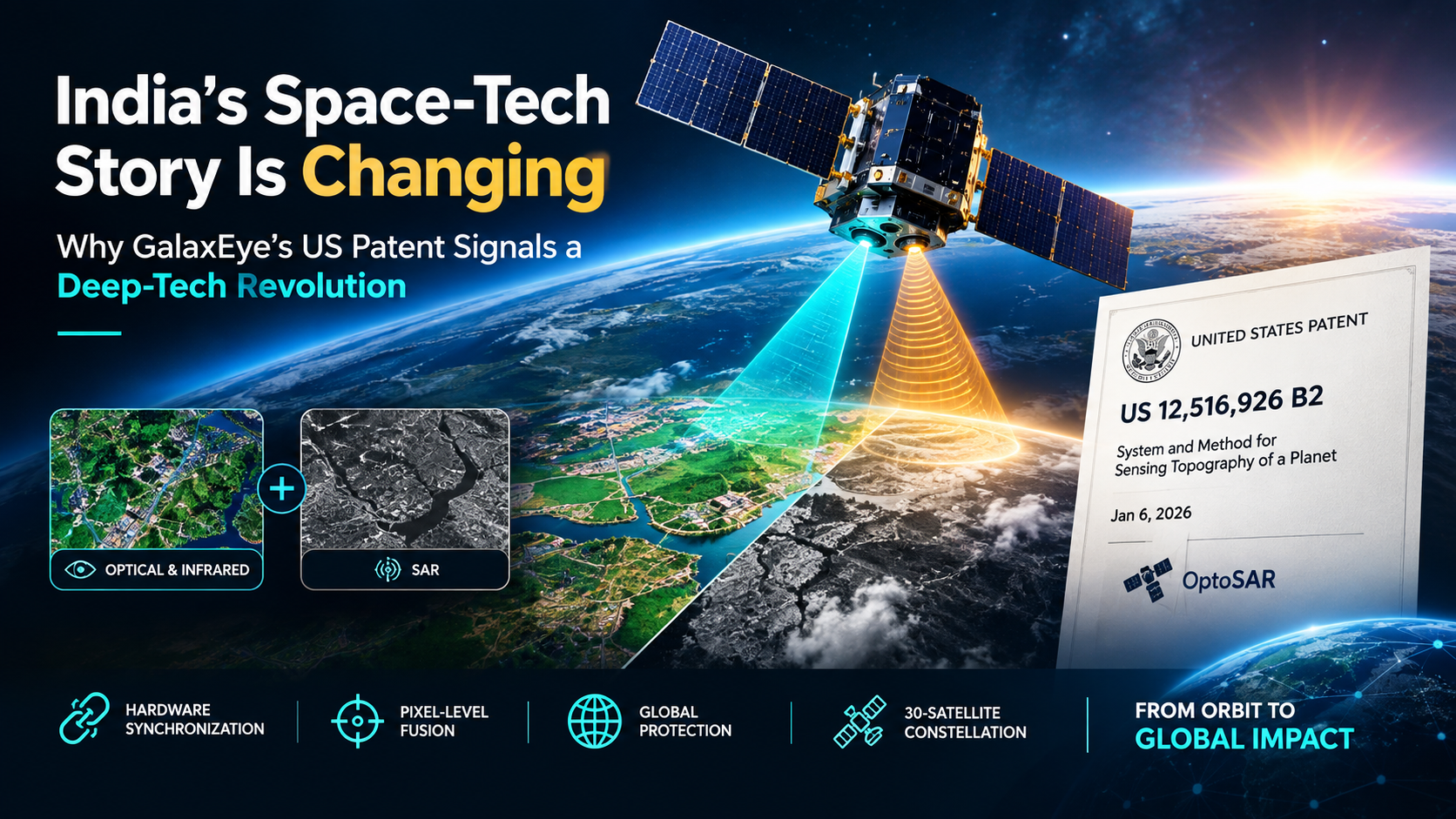
India's Space-Tech Story Is Changing: Why GalaxEye’s US Patent Signals a Deep-Tech Revolution
Something fundamental is shifting in Indian space technology. The most compelling story unfolding today is not simply that more satellites are reaching orbit or that a wave of fresh startups is entering the sector. The true shift is that Indian companies are starting to build proprietary deep technology, protect it through patents, and carry that intellectual property directly into international markets.
A major development involving Bengaluru-based space startup GalaxEye Space Solutions provides a clear window into that strategic shift.
The Problem GalaxEye Set Out to Solve
Imagine trying to understand a specific patch of Earth from orbit:
- Optical & Infrared Sensors: Give you a sharp, intuitive visual picture. This makes it simple to classify vegetation, roads, and infrastructure. However, these sensors are completely blinded by nightfall, heavy cloud cover, and smoke.
- Synthetic Aperture Radar (SAR): Emits microwave signals to map terrain through dense clouds, storms, and total darkness. However, SAR imagery operates on entirely different physical principles, capturing the world in a way that is difficult to visually interpret.
Traditionally, combining these two datasets meant attempting to cross-reference images taken by separate satellites orbiting at different angles, altitudes, and time intervals. That mismatch created temporal gaps and spatial misalignments, making pixel-by-pixel comparisons nearly impossible.
The Solution: OptoSAR Hardware Synchronization
GalaxEye’s technology, branded OptoSAR, was engineered to solve this hardware disconnect at the source.
Instead of treating optical and radar sensing as separate, loosely related data sources, the system synchronizes both instruments at the sensor level. As a result, both observations are spatially and temporally aligned from the exact moment they are captured in space.
The Patent Behind the Idea: US Patent No. 12,516,926 B2
GalaxEye has been granted US Patent No. 12,516,926 B2, titled "System and Method for Sensing Topography of a Planet," issued on January 6, 2026, with GalaxEye Space Solutions Pvt. Ltd. named as applicant and assignee.
The application entered the US via a Patent Cooperation Treaty (PCT) filing claiming priority back to an Indian filing from July 2021. This timeline is a clear sign of a deliberate, multi-year IP strategy rather than an opportunistic filing.
Key Innovations in the Claimed Architecture
- Hardware Co-Location: Pairs an optical/infrared sensor with a microwave (radar) sensor on a single vehicle, whether a spacecraft, aircraft, or satellite.
- Active Alignment: Incorporates a synchronizer unit that uses motion sensors and actuators to keep the beam-centers of both sensors locked toward the exact same ground target.
- Pixel-Level Co-Registration: An onboard processor fuses the resulting datasets at the individual pixel level, rather than the coarser feature or decision levels relied on by legacy workflows.
"Its uniqueness lies in synchronising optical and SAR sensors at the system level to deliver inherently aligned, spatially and temporally matched Earth observation data. This is not only a significant technical innovation but also has strong commercial potential across applications requiring richer, more actionable intelligence."
Dr. S. Somanath, Former ISRO Chairman
Why a US Patent Grant Matters
For a deep-tech startup, a patent grant is far more than a legal formality. It is a core piece of commercial strategy.
GalaxEye has described itself as the first Indian startup to receive a US patent specifically for satellite imaging technology. While based on the company's own announcement and not independently verified across every Indian space startup, the underlying business signal remains clear.
- Global Protection: It protects a specific technical architecture in one of the world's most consequential IP jurisdictions.
- Commercial Scalability: This protection comes as GalaxEye prepares to deploy a planned 30-satellite constellation over the next five years.
- In-House Capabilities: The push is backed by their recent acquisition of Bengaluru-based spacecraft engineering firm StarOps to scale internal manufacturing.
From a Government-Led Story to a Private Ecosystem
For decades, India's space story ran almost entirely through ISRO. That public foundation remains vital, but it is no longer the entire picture.
The 2023 Indian Space Policy opened the sector to far greater private participation across the entire value chain, with IN-SPACe serving as the promoting and authorizing body for private space activity.
Shifts in Ecosystem Dynamics
- Government Foundation: Driven historically by ISRO, focusing on core infrastructure, institutional R&D, and centralized launches.
- Private Commercial Sector: Accelerated by the 2023 Space Policy and regulated by IN-SPACe, giving rise to private Earth-observation constellations and proprietary global IP strategies.
GalaxEye is not operating in isolation:
- Private EO Consortium: A consortium led by Pixxel, alongside Dhruva Space, SatSure, and PierSight, is building India's first privately led national Earth-observation constellation, backed by more than ₹1,200 crore.
- Capital Inflow: Pixxel recently closed a $100 million Series C round to expand beyond hyperspectral imaging into broader Earth-intelligence infrastructure.
The competitive landscape in this sector is no longer just about who can put hardware into orbit. It is about who owns the underlying sensing architecture and can legally defend it globally.
Read the Portfolio, Not Just the Headline
From an IP-analysis standpoint, the most revealing narrative sits below the initial patent headline.
Filing-year data for this patent family shows activity building steadily from 2021 onward, with operating steps in 2022 and 2024. It also highlights repeated inventor contributions from key engineers Pranit Mehta and Rakshit Bhatt across the family.
That pattern forms a concrete record of technical decision-making over several years:
- What the team considered critical to protect early on.
- Where they anticipated the technology would eventually require international legal coverage.
A single "US patent granted" headline is just a snapshot. A patent portfolio, tracked over time, reveals far more about a deep-tech company's long-term strategic intent.
Key Takeaways for the Future of Space-Tech
- IP Defensibility Over Hardware: The next phase of India's space economy will be defined less by who can launch, and more by who can combine strong engineering with a well-built IP position.
- Replication Defense: Technical ideas can be replicated and products out-competed. A properly built patent portfolio, filed early, registered in key international jurisdictions, and backed by a coherent inventor strategy, creates a true economic moat.
- Global Intent: GalaxEye's US patent stands as a key milestone for one company and a marker for India's private space sector as a whole: technologies and IP strategies are now being built for the global stage from day one.
Explore the Indian Space-TechDashboard