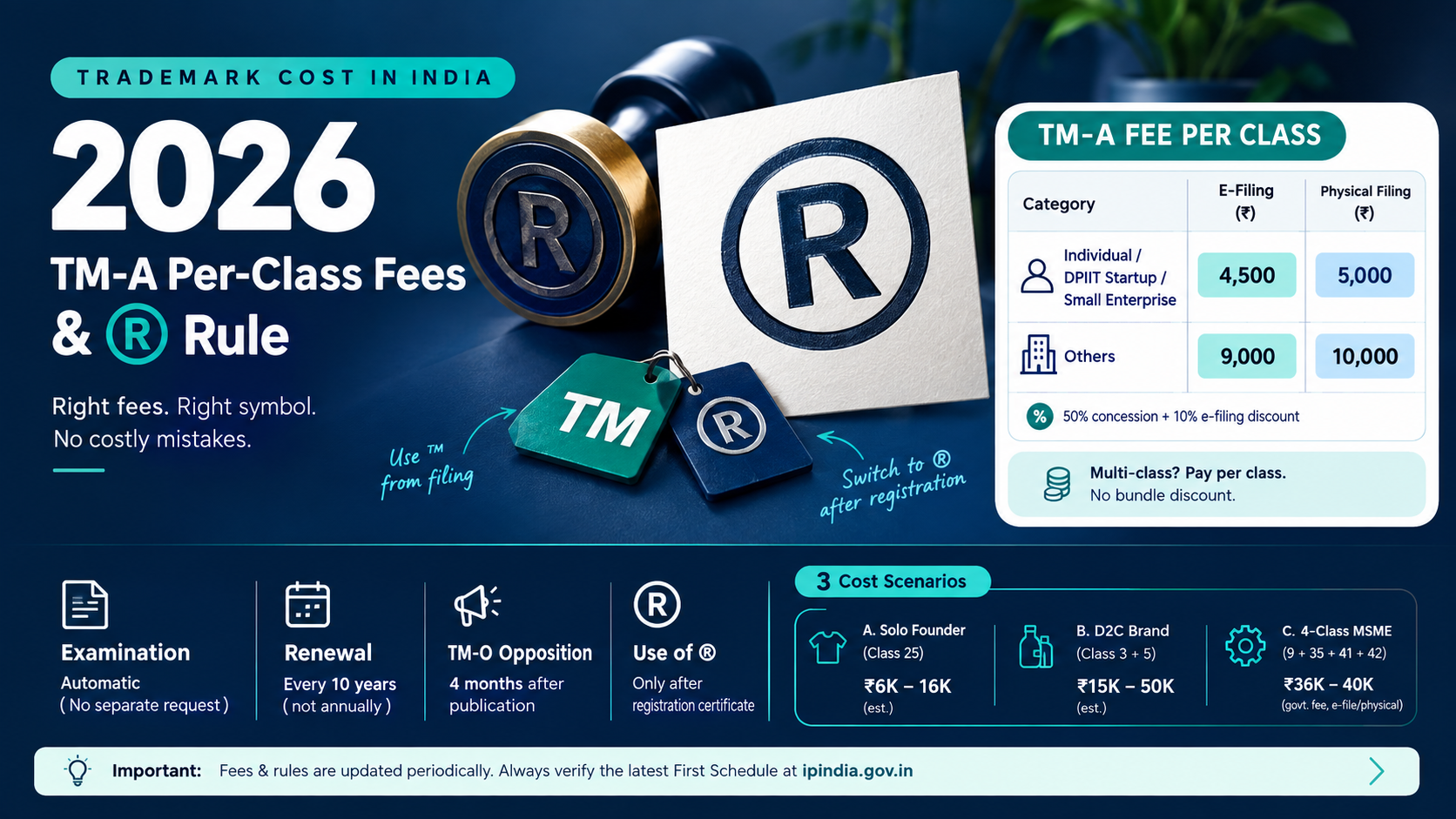
Trademark Cost in India 2026: TM-A Per-Class Fees & ® Rule
Most published "trademark cost India" guides overstate the rebate by framing it as a flat 80% discount on filing fees. The structural truth under the Trade Marks Rules, 2017 is that trademark official fees reside in the First Schedule of those Rules, which splits applicants into two categories: Individuals / DPIIT-recognised Startups / Small Enterprises versus Others. Individuals, DPIIT startups, and small enterprises pay a 50% concession on the Others fee, not an 80% rebate, and a further 10% statutory discount applies when filing electronically rather than in physical form. Apply both correctly and a Class 25 TM-A runs ₹4,500 per class under e-filing against ₹9,000 per class for Others e-filing. A founder who reads a generic "80% rebate" framing overpays across class expansion, and a founder who reads "Schedule I versus Schedule II" imports structural labelling the Trade Marks Rules First Schedule does not actually use.
TM-A Is Class-Counted With an E-Filing Discount
TM-A application fee under Section 18 read with Rule 21 of the Trade Marks Rules, 2017 is charged once per Nice Classification class in the First Schedule. A D2C brand that needs Class 3 (cosmetics, cleaning preparations) and Class 5 (herbal/wellness) coverage pays the First Schedule per-class fee twice. There is no multi-class bundle discount.
The First Schedule distinguishes electronic filing from physical filing, with a 10% statutory discount on e-filing applied on top of the 50% concessional tier. On e-filing, an Individual, a DPIIT-recognised Startup, or a Small Enterprise pays ₹4,500 per class, while an Other filer pays ₹9,000 per class. On physical filing, the same Individual, DPIIT-recognised Startup, or Small Enterprise pays ₹5,000 per class, while an Other filer pays ₹10,000 per class. The 50% concession runs from the Others e-filing rate of ₹9,000 down to the concessional e-filing rate of ₹4,500; the additional 10% e-filing discount runs from the concessional physical rate of ₹5,000 down to the concessional e-filing rate of ₹4,500, and a parallel ₹10,000 to ₹9,000 discount applies on the Others tier. Verify both per-class figures against the current First Schedule published on the Trade Marks Registry page at ipindia.gov.in before quoting in any client-facing communication; the First Schedule is updated periodically.
First Schedule Eligibility Categories
The First Schedule's two-category split is structural. The lower-fee category applies to Individuals, DPIIT-recognised Startups, and Small Enterprises filing on their own behalf. Others pay the higher tier, including foreign-domiciled filers, large entities, and Indian entities that do not meet the trade-mark "small entity" eligibility rule.
Cross-regime trap 1: The trade-mark "small entity" eligibility test under the First Schedule is structurally distinct from the Patent Rules Form 28 reduced-tier mechanism under Rule 6 of the Patents Rules, 2003. Do not paraphrase the Patent Rules Form 28 framework into a trade-mark filing.
Cross-regime trap 2: A foreign-domiciled startup with no Indian DPIIT recognition pays the Others tier on TM-A. A Series-B Delaware C-corp with a Bengaluru subsidiary schedules TM-A at the Others rate on the foreign parent's mark. The Indian subsidiary's separate DPIIT recognition, if held, would re-route the Indian TM-A filing into the Individuals/Startups tier, but the foreign-parent mark applied in India through the foreign parent alone does not qualify.
Examination Is Automatic, Renewal Is Every 10 Years
Examination under Section 18(1) of the Trade Marks Act, 1999 is automatic upon TM-A filing. There is no separate "request for examination" form for trade-marks, structurally unlike the patent Form 18 mechanism under Section 11B read with Rule 24B of the Patents Rules, 2003. Do not import patent Form 18 mental models into trade-mark prosecution.
TM-R renewal under Section 12 read with Rule 25 of the Trade Marks Rules, 2017 is filed every 10 years from the registration date, not annually. The trade-mark regime does not run an annual annuity clock comparable to patent Rule 80 renewals. The First Schedule's lower-tier eligibility flows into TM-R provided it holds at the renewal filing date; a startup that has crossed the DPIIT ten-year-from-incorporation ceiling by the 10-year TM-R trigger reverts to the Others tier.
TM-O: The Four-Month Opposition Window
TM-O opposition under Section 21 read with Rule 42 is filed by third parties during the four-month window after Trade Marks Journal publication under Section 20. This is defensive exposure, not the applicant's own filing. Missed TM-O windows cannot be re-opened. Defensive counsel cost on a contested TM-O runs ₹40,000 to ₹1,20,000 in agent and counsel fees, often higher for Class 9 (software) or Class 3 (cosmetics) marks facing structured opposition. The contested cycle on a Section 9 (absolute grounds) or Section 11 (relative grounds) refusal can run 30 to 48 months.
The ® Trap Under Section 107
® symbol use is reserved strictly for marks whose Section 23 registration certificate has issued. ® use on a TM-A-pending mark is a Section 107 false-representation exposure and can attract Amazon Brand Registry repeal on the IP Accelerator programme. ™ symbol use is appropriate from TM-A filing forward, including throughout the publication and examination phase. Switch from ® to ™ the moment the TM-A filing receipt arrives; switch back to ® on Section 23 certificate issuance.
Three Cost Scenarios (Quick Reference)
Scenario A: Solo founder, single Class 25 (clothing) TM-A, Individuals/Startups tier (natural person), e-filed. Per-class First Schedule fee: ₹4,500. Total cost-to-registration estimate approximately ₹6,000 to ₹16,000 in 2026. Journal publication at month 12 to 18, no opposition, registration certificate at month 18 to 24.
Scenario B: D2C brand, two-class (Class 3 + Class 5) Amazon Brand Registry enrolment, DPIIT-recognised Startup tier, e-filed. Per-class First Schedule fee: ₹4,500 × 2 = ₹9,000. Total filing fee estimate approximately ₹15,000 to ₹50,000, plus contested opposition risk ₹40,000 to ₹1,20,000 per contested class. Brand Registry eligibility typically activates on filing receipt within seven working days under Amazon IP Accelerator.
Scenario C: Four-class MSME portfolio (Class 9 + 35 + 41 + 42), Others tier (no DPIIT recognition), e-filed. Per-class First Schedule fee: ₹9,000 × 4 = ₹36,000 government-fee total on e-filing. If filed physically at the Others tier, the per-class rate is ₹10,000 and the government-fee total rises to ₹40,000 across four classes. Add ₹40,000 to ₹1,00,000 in agent fee, depending on portfolio ambition and complexity.
Honest limit on these figures: each rupee value is a starting point only. The First Schedule of the Trade Marks Rules, 2017 is updated periodically; verify against the current Trade Marks Rules notification on the Trade Marks Registry page at ipindia.gov.in before quoting.
Frequently Asked Questions
Q — Is trademark fee rebate 80% for startups? No. The First Schedule's structural concession is 50% from the Others rate (₹9,000 e-filing down to ₹4,500 e-filing per class), plus an additional 10% e-filing discount on top. That is a 50% concession plus a 10% e-filing discount, not an 80% rebate.
Q — Do I file a separate request for examination? No. Examination under Section 18(1) is automatic upon TM-A filing. There is no separate examination-request form for trade-marks.
Q — When can I use ®? Only after the Section 23 registration certificate has issued. Use ™ until the certificate is in hand. ® use on a TM-A-pending mark is a Section 107 false-representation exposure.
Q — How long does registration take? Six to 14 months to first examination report, four-month TM-O opposition window after publication, and Section 23 certificate at month 18 to 24 in uncontested cases.
Q — Is Amazon Brand Registry eligibility automatic? Yes, under the IP Accelerator framework. The Indian trade-mark filing receipt is the qualifying Brand Registry proof document, typically displayable on the portal within seven working days.
Q — When does TM-R fall due? Ten years from registration date, every ten years thereafter. No annual annuity clock.