Cost of Trademark Registration in India (2026): Official Fees, Timelines & Hidden Costs
Cost of Trademark Registration in India (2026): Official Fees, Timelines & Hidden Costs
Launching a brand without a registered trademark leaves your business vulnerable to counterfeiters, brand hijacking, and costly legal disputes. However, calculating the actual budget for trademark protection in India can feel confusing due to varying applicant categories, multi-class rules, and unexpected office action fees.
This guide provides a transparent, informational breakdown of official IP India government fees, realistic 2026 timelines, and how attorney fees work—ensuring your budget remains predictable.
Official Government Fees (Form TM-A)
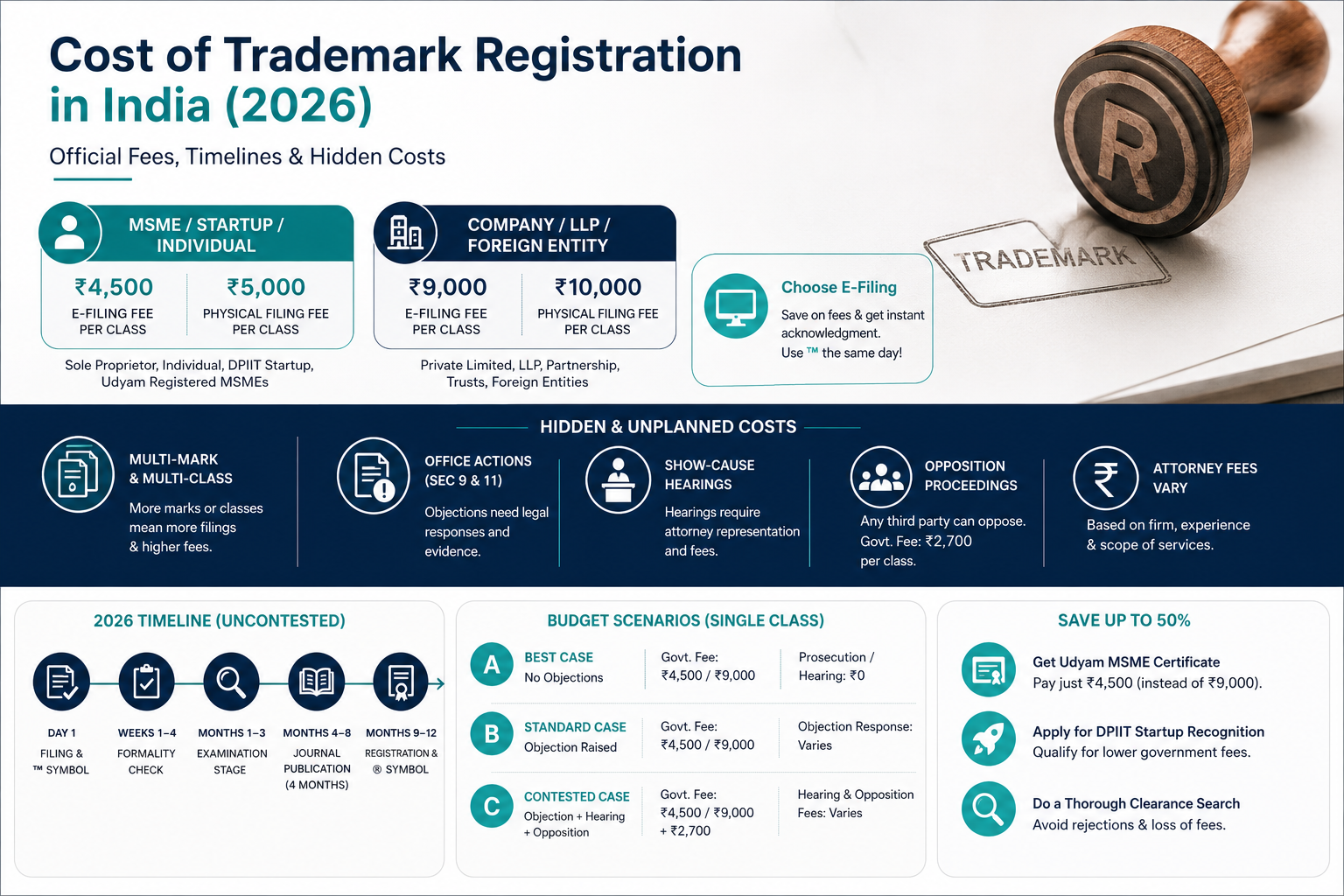
The Intellectual Property Office in India (IP India) categorizes applicants into two pricing brackets under the Trade Marks Rules. Government fees are assessed per class, per mark.
1. Individuals, Startups & MSMEs
- E-Filing Fee: ₹4,500 per class / per mark
- Physical Filing Fee: ₹5,000 per class / per mark
- Eligible Applicants: Sole Proprietors, Individuals, DPIIT-Recognized Startups, and Udyam-Registered MSMEs.
- Key Requirement: Valid Aadhaar/PAN for individuals, DPIIT Certificate for startups, or Udyam Certificate for MSMEs.
2. Private Limited Companies, LLPs & Foreign Entities
- E-Filing Fee: ₹9,000 per class / per mark
- Physical Filing Fee: ₹10,000 per class / per mark
- Eligible Applicants: Private Limited Companies, LLPs, Partnership Firms, Trusts, and Foreign Corporate Entities.
- Key Requirement: Certificate of Incorporation or Partnership Deed.
Pro Tip: Always choose E-Filing. Beyond saving ₹500–₹1,000 per class in official government fees, e-filed applications generate an instant acknowledgment receipt, allowing you to legally use the ™ symbol on the exact same day.
Understanding Attorney & Professional Fees
Unlike government fees, which are fixed by law, professional fees vary significantly depending on the firm, the attorney’s experience, and the complexity of your application.
Why Professional Fees Depend on the Firm or Attorney:
- Boutique IP Firms vs. Freelancers: Specialized IP firms often charge a comprehensive fee that covers end-to-end prosecution, while individual consultants or online aggregators may offer low initial filing costs but charge separately for every follow-up notice.
- Attorney Seniority & Expertise: Experienced IP attorneys who specialize in complex clearance searches and opposition defense command higher hourly or fixed retainer rates.
- Scope of Service: Some firms offer flat-rate packages (covering search, drafting, and initial response), while others bill on a pay-as-you-go model for examination responses and show-cause hearings.
Typical Professional Services Handled by Attorneys:
- Trademark Clearance Search: Cross-checking the IP India database for phonetic, visual, and conceptual similarities across all 45 classes before filing.
- Application Drafting & Class Selection: Selecting the correct Nice Classification and drafting tailored specifications of goods/services.
- Responding to Examination Reports: Legal drafting to overcome Section 9 (lack of distinctiveness) or Section 11 (similarity to existing marks) objections.
- Show-Cause Hearing Representation: Appearing before the Trademark Registry examiners via video conference or in-person hearings.
Hidden & Unplanned Costs in Trademark Registration
Unplanned expenses usually arise during the prosecution stage if your application encounters procedural hurdles or third-party objections.
1. Multi-Mark and Multi-Class Multipliers
- Name vs. Logo: Registering your word mark ("Brand Name") and logo mark ("Visual Design") as separate applications requires 2 separate TM-A filings.
- Multiple Classes: Selling physical apparel (Class 25) and operating an e-commerce website (Class 35) requires protection across two classes. A corporate entity will pay
2 x ₹9,000 = ₹18,000in government fees alone.
2. Office Actions & Objections (Section 9 & 11)
Roughly 30% to 40% of applications receive an Examination Report raising objections. Resolving these requires drafting formal legal responses and collecting evidence of brand usage.
3. Show-Cause Hearings
If the Registry is not satisfied with the written response to an objection, a hearing is scheduled. Representing your brand at a hearing requires engaging an authorized Trademark Agent or Attorney.
4. Opposition Proceedings (Form TM-O)
During the 4-month journal publication window, any third party can oppose your mark.
- Official Opposition Fee: ₹2,700 per class (Government Fee).
- Legal Defense Costs: Preparing counter-statements, gathering evidence of usage, and attending opposition hearings depend on the attorney or law firm engaged.
2026 Timeline: How Long Does Registration Take?
Under current IP India processing standards, an uncontested application takes 6 to 12 months from filing to receiving the final registration certificate.
- Day 1 (Filing & ™ Symbol): You can legally affix the ™ symbol next to your mark as soon as your TM-A application is submitted and the receipt is generated.
- Weeks 1–4 (Formality Check): Verification of documents, user affidavits, and logo classification.
- Months 1–3 (Examination Stage): The Registry issues an Acceptance order or publishes an Examination Report with objections.
- Months 4–8 (Journal Publication): The mark is advertised in the official weekly Trade Marks Journal for a mandatory 4-month public opposition window.
- Months 9–12 (Registration & ® Symbol): If no opposition is filed, the digital Registration Certificate is issued, allowing you to use the ® symbol.
How Businesses Can Save 50% on Official Government Fees
- Obtain an Udyam MSME Certificate: Indian small businesses and partnerships can instantly qualify for the lower ₹4,500 government fee (instead of ₹9,000) by registering under the Udyam scheme before filing.
- Apply for DPIIT Startup Recognition: Startups recognized by DPIIT pay the reduced ₹4,500 government fee per class.
- Conduct a Thorough Clearance Search: Investing in a pre-filing search prevents losing government fees on an application that faces immediate rejection due to an existing identical mark.
Budgeting Scenarios (Single Class)
Here is how total registration costs typically break down depending on the path an application takes:
Scenario A: Best-Case / Smooth Registration (No Objections)
- Official Government Fee: ₹4,500 (MSME/Startup) or ₹9,000 (Company)
- Attorney / Professional Fee: Depends on the chosen firm
- Prosecution / Hearing Costs: ₹0
Scenario B: Standard Case (Facing an Examination Objection)
- Official Government Fee: ₹4,500 (MSME/Startup) or ₹9,000 (Company)
- Attorney / Professional Fee: Depends on the chosen firm
- Objection Response Drafting: Fee varies by attorney or firm
Scenario C: Contested Case (Objection + Hearing + Third-Party Opposition)
- Official Government Fee: ₹4,500 or ₹9,000 (TM-A) + ₹2,700 (Opposition Fee)
- Attorney / Professional Fee: Depends on the chosen firm
- Hearing & Opposition Representation: Billing varies based on attorney experience and case complexity