DPIIT Model IPR Policy for Indian Universities: NIRF Innovation Ranking Impact
DPIIT Model IPR Policy for Indian Universities: NIRF Innovation Ranking Impact
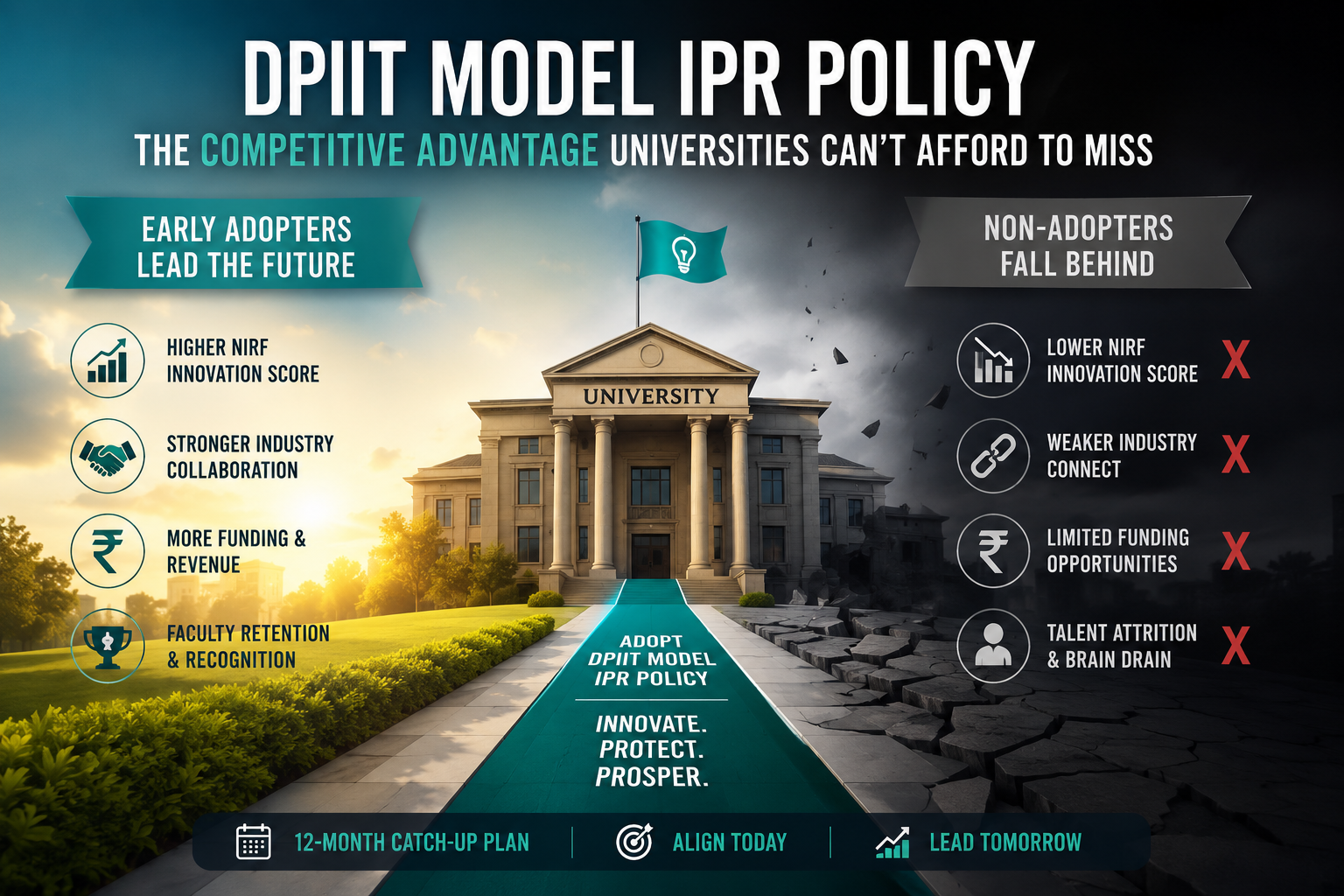
The Indian university IP ecosystem is bifurcating into two cohorts. Universities whose IP programmes already resemble the DPIIT Model IPR Policy for Academic Institutions formally promulgated alongside the National Intellectual Property Rights Policy 2016 by the Department for Promotion of Industry and Internal Trade (DPIIT) through its Cell for IPR Promotion and Management (CIPAM) operate on named-disclosure workflows, titled IP cells, transparent revenue-share, and TTO-led prosecution. Universities without these systems are operating outside the recommended institutional framework. The early-adopter cohort did not need fresh mandates in 2025 because they had already done the work; the non-adopter cohort is voluntarily forgoing the documented advantages NIRF Innovation ranking capture, central-grant IP clause clearance, faculty retention, and industry funding that DPIIT's recommended framework was specifically designed to enable.
This post maps the adoption gap, surfaces the measurable advantages that early adopters already hold, names the institutional archetypes on both sides, and gives non-adopter Vice-Chancellors a 12-month catch-up path that internal practice has proven to be realistic.
A Note on the Policy Itself DPIIT's Model IPR Policy for Academic Institutions
The DPIIT Model IPR Policy for Academic Institutions is a recommended institutional template, NOT a binding statutory directive. Universities are free to design their own IP policy, but DPIIT's model has become the de facto benchmark because it maps directly onto the questions that grant agencies, accreditation bodies, and ranking systems now ask. CIPAM has supported the model's evolution across multiple revisions; the 2025 update consolidates prior guidance into a single document that universities can adopt by reference. Adoption is voluntary. The financial and institutional advantages in this post flow from aligning institutional practice with the DPIIT recommended framework, not from any new mandate.
The four operating principles of the DPIIT Model are: default institutional ownership of inventions arising from institutional resources; a mandatory invention-disclosure workflow through the institutional IP Cell before any public disclosure; a transparent revenue-share between inventor and institution (typically a 60:40 flat split or an Indian Institute-style slab); and an institutional IP Management Fund with a defined corpus share.
The Adoption Scorecard Three External Scorecards Reading IP into Institutional Performance
Indian universities are measured on three main scorecards, two global and one India-only. The National Institutional Ranking Framework (NIRF), published annually by the Ministry of Education since 2016, gives explicit weight to "IP Filed," "IP Granted," and "IP Licensed" inside its dedicated Innovation and Startup dimension. Scopus-derived citation metrics feed QS World University Rankings through citations per faculty from academic publications (Scopus-indexed journals and conference proceedings), and to a lesser extent feed Times Higher Education through research-intensity proxies. QS and THE do not separately compute patent citations; instead, IP activity flows into institutional ranking via industry collaboration indicators, research income, and the institutional-research-reputation survey. Universities with active patent programmes see ranking impact primarily through the industry-collaboration and research-income channels, and through NIRF's Innovation sub-metric.
Outside the rankings, IP programme maturity controls a separate budget reality. The IP clauses attached to DST, DBT, MeitY, and ICMR grant deliverables in 2025-26 routinely reference institutional IP policy, deferring questions like inventor share and equity-licensing mechanics to the applicant's own policy. A university without a clear policy at the time of grant negotiation is negotiating from a deficit; a university with a DPIIT-aligned policy can sign cleanly. The 12-month catch-up path described below matters here precisely because the next DST / DBT calls close between August 2026 and February 2027.
The Early-Adopter Cohort IIT Madras, IISc Bengaluru, IIT Bombay, IIT Kanpur
Six institutions in India currently hold the deepest institutional-IP practice. IIT Madras has been the leading institutional filer at the Indian Patent Office for several consecutive years and has integrated its IP Cell with the IIT Madras Research Park, producing dozens of academic startups. IISc Bengaluru operates the Society for Innovation and Development (SID), its TTO, which has spun out deeptech companies in life sciences and aerospace over two decades. IIT Bombay runs SINE (Society for Innovation and Entrepreneurship), a TTO-plus-incubator covering approximately 100+ spinoffs. IIT Kanpur operates the SIDBI Innovation and Incubation Centre and is widely cited as the reference point for the revenue-share slab model. IIT Delhi runs FITT (Foundation for Innovation and Technology Transfer). IIT Kharagpur runs SRIC (Sponsored Research and Industrial Consultancy). These six institutions collectively produce the bulk of Indian academic patent output, attach the highest-value grant IP clauses, and consistently anchor the NIRF Top 10 in the Overall and Innovation categories. They aligned their internal IP policies with DPIIT's recommended framework from the outset and the running yield has compounded across the last decade.
The Emerging-Tier Adopters New IITs, IISERs, IIMs, and Selected Private Universities
Between 2018 and 2026, several institutions moved from "no policy" to "explicit policy" and now operate on DPIIT-aligned terms. IIT Hyderabad, IIT Indore, IIT Patna, and IIT Tirupati filed their first policy texts in the 2019-2022 window. IISER Kolkata, IISER Pune, and IISER Bhopal use the same disclosure-then-assignment workflow. BITS Pilani operates a TTO model via its Work Integrated Learning Programmes office. The newer IIMs (IIM Ahmedabad, IIM Bangalore, IIM Calcutta, IIM Lucknow) have built disclosure workflows around their case-study repositories and faculty research. Amrita Vishwa Vidyapeetham, SRM Institute of Science and Technology, VIT Vellore, and Manipal Academy of Higher Education have built policy-heavy TTOs under their incubation cells. These universities can formally adopt the DPIIT-aligned text on Academic Council agendas at low friction.
St Peter's Institute of Higher Education and Research (SPIHER) is one of the most recent Indian universities to publish a DPIIT-aligned IPR policy on its institutional website in May 2026, and is a useful lightweight template for the emerging tier. The policy text is short, covers ownership, disclosure, and revenue share, and runs directly off the DPIIT template.
The Non-Adopter Cohort Most State Universities, Most Private Indian Universities, Most Central Universities
The Indian higher-education landscape outside the early-adopter and emerging tiers runs more than 1,100 universities. NIRF publishes Innovation scores for only a fraction of them, and the bulk of state universities, deemed-to-be universities, central universities, and affiliated colleges report near-zero patent output. The structure of the non-adopter problem is consistent: there is rarely a published IP policy at all, the disclosure-authority question (does the invention need to be reported to the institution?) is unresolved, and the agency's portfolio of filed patents on record at the Indian Patent Office sits in the single digits.
This cohort includes most state universities in Uttar Pradesh, Madhya Pradesh, Bihar, Jharkhand, Odisha, and the North-East. It includes the non-top-200 deemed universities and most private Indian universities without an IIT-style reputation. It includes most central universities outside the IITs / IISc / IISER cluster Delhi University, JNU, Jamia Millia Islamia, BHU, AMU, and the bulk of the state-cluster universities file close to nothing per year.
The reason is structural rather than pejorative. Disclosure policy was a faculty-reserved domain in India for most of the post-independence period, and only the institutions with federal funding and an explicit research mandate built the operational infrastructure. With the DPIIT recommended framework now publicly available and NIRF Innovation providing a reward structure, the cost of building the IP Cell is meaningfully lower than the cost of being left out of the next ranking cycle.
Strategic Advantage #1 NIRF Innovation Sub-Metric Capture
The NIRF Innovation sub-metric is computed across IP Filed, IP Granted, IP Licensed, and a small number of additional startup metrics. Indian universities with active IP programmes consistently anchor the top of this dimension year after year, and the gap between the IIT / IISc cohort and the rest is structural; it does not close naturally without deliberate institutional effort. A non-adopter that wants NIRF Innovation lift in the next publishing cycle cannot fake the metric by hiring a few consultants it has to file patents, grant patents, and license patents. That requires the disclosure workflow, the TTO leadership, the patent agent retainer, and the revenue-share policy that DPIIT's recommended framework codifies.
This makes NIRF Innovation a realistic and accessible lever rather than a global-ranking lever. State and central universities that file their first batch of patents within 12-18 months of policy adoption typically see measurable NIRF Innovation dimension movement within 2-3 cycles.
Strategic Advantage #2 Central Grant IP Clause Compliance
The grant IP clauses in 2025-26 DST Inspire, DBT-BIRAC, MeitY-IDEA, and ICMR Extramural calls all reference institutional IP policy as a precondition for negotiating inventor-share and equity-licence terms. Universities with DPIIT-aligned policies can sign grant IP clauses on the institutional IP Cell's authority; universities without policies have to negotiate each clause individually, often losing months while the grant period elapses. Central-grant compliance is the single most quantifiable benefit of policy adoption, because each grant retained through clean IP-clause clearance brings money into the institution that would otherwise have been deferred.
This is also a faculty-retention lever. Sponsored grants of ₹2 crore or more are typically laundered through the institution. Faculty researchers pursuing patent prosecution value a clean authorisation chain filing IP and getting grants cleared off the same document. Universities that lack the unified TTO-and-grants office lose grant cycle velocity; with it, they gain it.
Strategic Advantage #3 Faculty Retention, Startup Output, and Industry Funding
Indian academic faculty migrate, particularly in applied engineering and life-sciences fields. IIT Madras, IISc, IIT Bombay, and IIT Kanpur faculty retention over a 5-year window is visibly higher than state-university retention, and the IP and startup output is one factor that drives that pattern. Faculty researchers who want to pursue patent-protected applied work value the institutional infrastructure that allows them to file, license, and start a company without months of internal-review loops. Universities with DPIIT-aligned IP programmes satisfy that need; the ones without it cannot, and those faculty leave within 3-5 years.
The startup-output lever is a direct line-item. Indian universities that operate an activated TTO function IIT Madras Research Park, IIT Bombay SINE, IISc SID, IIT Kanpur SIDBI, IIT Delhi FITT consistently support far higher numbers of academic startups than universities without that infrastructure. DPIIT's model clause permitting waived upfront fees for researcher-led academic ventures is explicitly engineered to expand this pattern. A non-adopter that aligns its policy with the DPIIT recommended framework and builds a TTO function within the year starts closing this gap on the 24-month horizon, and the industry-funded research income that flows through the TTO is a more durable revenue stream than licensing royalties at the Indian scale.
Strategic Advantage #4 Industry Collaboration and Research Income
Industry collaboration is a documented QS and THE proxy, and is more reliably influenced by IP programme maturity than the broader ranking score. Universities with active TTOs handle industry-sponsored research differently from universities without them. The Indian rankings that include an explicit "industry-funded research" line item including NIRF's Innovation dimension, and QS's industry-collaboration sub-score show early adopters consistently ahead. The realistic impact on overall NIRF Overall ranking position is a single-digit to low-teens position shift over 2-3 cycles, rather than dramatic but the cumulative effect across NIRF Innovation, NIRF Overall, industry research income, and faculty retention compounds.
Strategic Advantage #5 International Recognition, Joint Programmes, and Bilateral Funding
Beyond QS and THE, several global indices now compute patents per faculty and academic spinoff count against institutional research profiles. Indian universities that score well on these metrics are seeing measurable shifts in global partnership flows joint degrees with European institutions, faculty visitations from US counterparts, joint grant awards with international collaborators. The DPIIT recommended framework, by formalising inventor share and academic startup waivers, closes the gap between Indian institutional practice and the standards these global indices expect. Universities with active IP programmes convert this visibility into measurable faculty exchanges and bilateral funding awards over 2-4 years.
What Non-Adopters Will Lose by 2028 if They Don't Catch Up
Three trajectories are visible in the 2025-2028 window. First, the NIRF Innovation gap will widen as the early-adopter cohort generates more filings, more grants, more licensing. By 2027, NIRF Top 100 positions for the non-adopter cohort will be harder to break into than they are today. Second, the central-grant pipeline will move against non-adopters as DST, DBT, and MeitY tighten IP-clause expectations in high-value calls. A university without DPIIT-aligned policy will see grant proposals deferred while IP-clause negotiation extends. Third, the faculty-retention and industry-funding gap will compound. Faculty leave for institutions with IP programmes; industry-sponsored research follows faculty. The compound effect is that a university that delay-adopts in 2028 starts its first policy cycle seven to ten years behind institutions that adopt in 2026.
A 12-Month Catch-Up Path for a Non-Adopter University
Months 1-3: Policy text. Pull the DPIIT Model IPR Policy for Academic Institutions verbatim, choose Option A (60:40 flat) or Option B (IIT-style slab with a Q figure aligned to the institution's annual royalty target), and place the text before Academic Council for adoption. Constitute the IP Cell Convenor, R&D Dean, one external Patent Agent with IN/PA credentials (verifiable against the IPO Register), one legal member and grant it filing authority.
Months 4-6: Disclosure workflow. Publish a one-page invention disclosure form on the institutional intranet, brief HoDs and Principal Investigators in faculty meetings, and start tracking disclosures even one disclosure per month in the first year is data the TTO needs. Retain a registered patent agent on per-filing retainer.
Months 7-12: First filings and prosecution calendar. File the first batch of Form 1 + Form 2 + Form 5 + Form 9 (when early publication is needed). Under the Patents (Amendment) Rules, 2024, Form 18 (Request for Examination) must be filed within 31 months from the priority date or date of filing, whichever is earlier, under Rule 24B of the Patents Rules, 2003; missing the deadline deems the application abandoned under Section 11B(4) of the Patents Act, 1970. Universities that want faster First Examination Reports (FERs) can file Form 18A along with Form 18 to invoke expedited examination under the Patents (Amendment) Rules, 2024 educational-institution applicants often receive FERs within 6 to 18 months on the expedited track, with total disposal/grant times of 2 to 3 years rather than the longer non-expedited timelines. By the end of month 12 the institution has its first 3-5 active filings on record at the Indian Patent Office, which is the absolute minimum portfolio size that registers under NIRF Innovation.
Beyond 12 months: First grant and the licensing clock. With the expedited examination track in use, first FERs are likely to arrive between months 13 and 30 from filing, and grants (if pursued aggressively) are realistic within 2 to 3 years of the priority date. Royalty revenue will not arrive in this cycle, but the institution is now operating inside the ranking, the grant-clause, and the industry-collaboration mechanisms that hold the next decade of measurable advantages open.
A Realistic First-Year Budget Envelope (Educational Reference)
For Senior Administrators planning the first 5-application batch, here is the realistic operating envelope for a state or central university adopting the DPIIT Model IPR Policy in 2026 (figures are presented as range estimates for educational reference and should be verified with the institution's retained Patent Agent before commitment):
- Prior-art search per disclosure: ₹30,000 – ₹60,000, depending on technical field breadth.
- Drafting (provisional + complete specification, claims, abstract): ₹40,000 – ₹80,000 per application, with engineering, biotech, and software-implemented inventions at the upper end.
- Government fees: substantially reduced under the recognised-educational-institution fee concession the institution pays only a small fraction of the default fee tier (equivalent to a 90 % official fee reduction), with Form 1, Form 2, Form 5, Form 9, and Form 18 all receiving the educational-institution rate.
- Form 18A expedited examination request: separate fee under the Patents Rules; educational institutions receive the same reduced rate.
- PCT international filing (where applicable): WIPO fees + agent fees + translation costs, on top of Indian prosecution cost.
- IP Cell overhead: administrative support, internal documentation, website disclosure portal moderate annual cost, scaled with disclosure volume.
Realistic working envelope: approximately ₹5 – ₹10 lakh all-in for a first-year 5-application programme. Government fees form only a small fraction of that envelope; the bulk is professional drafting and prosecution work, which is precisely the work that produces valid patents rather than rejected ones. Operating cost beyond the first year scales with disclosure volume and with PCT filing decisions.
Frequently Asked Questions DPIIT Model IPR Policy Adoption for Indian Universities
Which Indian Universities Have Already Adopted the DPIIT Model IPR Policy?
There are two cohorts to distinguish. Early adopters are universities whose pre-existing IP policy was the institutional reference point when DPIIT formulated the model; these include IIT Madras, IISc Bengaluru, IIT Bombay, IIT Kanpur, IIT Delhi, and IIT Kharagpur. Emerging-tier adopters are universities that have explicitly adopted or aligned with the DPIIT model in recent years; these include newer IITs (Hyderabad, Indore, Patna, Tirupati), IISER Kolkata / Pune / Bhopal, the newer IIMs, BITS Pilani, and selected deemed-to-be universities such as SPIHER, Amrita Vishwa Vidyapeetham, SRM, VIT, and Manipal.
How Will Adopting the DPIIT Model Improve My NIRF Innovation Ranking?
The NIRF Innovation sub-metric scores institutions across IP Filed, IP Granted, IP Licensed, and startup metrics. Universities adopting the DPIIT recommended framework typically see measurable NIRF Innovation dimension lift within 2-3 cycles because the policy produces the filings that the metric counts. The realistic ceiling for an individual institution in overall NIRF Overall rank is a single-digit to low-teens position shift over 2-3 cycles, plus material gain in the NIRF Innovation dimension.
Will Adoption Improve Faculty Retention?
The signal is positive for applied-science and engineering faculty, where research-intensity-weighted career decisions are common. Universities that align with the DPIIT recommended framework and build the TTO function within 12-24 months typically see stronger faculty retention in those fields, and stronger industry-funded research contracts flowing through the TTO.
Is Adoption Affordable for a State University?
The recognised-educational-institution fee concession under Rule 6 of the Patents Rules, 2003 (a 90 % official fee reduction, with the institution paying only the small-entity rate) is the single largest cost lever. The realistic first-year operating budget for a state or central university filing its first 5 patent applications is ₹5 – ₹10 lakh all-in, dominated by professional prior-art search, drafting, and prosecution work. Operating cost beyond the first year scales with disclosure volume.
Do I Need the DPIIT Model to File My First Patent?
No. Form 1 under the Patents Act, 1970 can be filed by any applicant, including an individual faculty member, at any time. Alignment with the DPIIT recommended framework is not a procedural precondition for filing a patent; it is the institutional policy that allocates ownership, disclosure, and revenue share on filing. Many Indian universities have filed patents without formal DPIIT alignment but typically with inventor-only ownership, no institutional licensing capability, and limited NIRF capture.
Which Universities Should I Benchmark Against?
For state universities benchmark against IIT Madras's pre-2015 IP policy and the IIT Kanpur revenue-share slab. For central universities benchmark against IISc SID bylaws and IIT Delhi FITT policy. For deemed-to-be universities with limited budget benchmark against the SPIHER model, which is the lightest documented DPIIT-aligned template currently published.
What Is the Single Largest Mistake in Adoption?
Adopting the policy text without standing up an institutional IP Cell that has filing authority. A DPIIT-aligned policy without operational authority still leaves the institution in the inventor-owns, institution-might-assign posture that the recommended framework was designed to replace. Boards that adopt DPIIT's recommended framework without delegating authority to the IP Cell have, in practice, signed paper that doesn't change operations.
Will Adoption Pull International Admissions?
The realistic impact on undergraduate admissions is modest, especially at the top IITs and IISc where admissions are entrance-test-driven. Postgraduate and Ph.D. admissions are more responsive; universities with active IP programmes see material lift in industry-sponsored Ph.D., sponsored M.S., and joint M.Tech pipelines over 2-3 years because IP signal correlates with research-income and faculty-project capacity.
How Fast Will Exams and Grants Run After Adoption?
Under the Patents (Amendment) Rules, 2024, institutions using Form 18A for expedited examination often receive First Examination Reports within 6 to 18 months, with grants often possible within 2 to 3 years. The standard non-expedited track is slower. Filing Form 18 (Request for Examination) within the 31-month Rule 24B deadline is the binding constraint on the standard track; Form 18A is the lever for institutions that want faster prosecution.
Key Terms Explained
DPIIT Model IPR Policy for Academic Institutions a recommended institutional template for university IP management, formulated by the Department for Promotion of Industry and Internal Trade (DPIIT) and its Cell for IPR Promotion and Management (CIPAM), and aligned with the National Intellectual Property Rights Policy 2016. Adopted voluntarily by Indian universities; the financial and ranking advantages in this post flow from alignment with the recommended framework rather than legal compulsion.
DPIIT the Department for Promotion of Industry and Internal Trade, under the Ministry of Commerce and Industry. Issues the National IPR Policy 2016 and the Model IPR Policy for Academic Institutions.
CIPAM Cell for IPR Promotion and Management, the DPIIT arm responsible for academic IP outreach and the practical iteration of the DPIIT Model IPR Policy.
National Institutional Ranking Framework (NIRF) the Ministry of Education's annual university ranking system, in use since 2016, with a dedicated Innovation dimension reading IP Filed, IP Granted, and IP Licensed.
Tech Transfer Office (TTO) the institutional unit (also called Technology Licensing Office, TLO) handling invention-disclosure triage, prior-art search, marketing, licensing, and post-deal compliance. Indian examples: IISc SID, IIT Bombay SINE, IIT Kanpur SIDBI, IIT Delhi FITT, IIT Madras Research Park.
Form 18 (Request for Examination) the prosecution-decision Form that moves a published Indian patent application to an examiner's desk. Under Rule 24B of the Patents Rules, 2003 (as amended by the Patents (Amendment) Rules, 2024), Form 18 must be filed within 31 months from the priority date or date of filing, whichever is earlier. Missing the deadline deems the application abandoned under Section 11B(4) of the Patents Act, 1970.
Form 18A (Request for Expedited Examination) the Form used by an applicant to invoke the expedited examination track under the Patents (Amendment) Rules, 2024. Educational-institution applicants using Form 18A often receive First Examination Reports within 6 to 18 months, with total grant timelines often within 2 to 3 years, depending on subject matter and examiner availability.
Section 39 of the Patents Act, 1970 the section controlling when an Indian-resident applicant may file abroad. The default rule is that an Indian priority application is filed first; 6 weeks elapse before the applicant may file abroad (PCT or direct national). Form 25 is the Foreign Filing Licence, mandatory either to lift the 6-week bar (early filing) or to permit direct foreign filing when no Indian priority exists. Indian universities in practice file an Indian priority, wait 6 weeks, then file PCT, with Form 25 reserved for genuinely compressed timelines.
Form 27 (working statement) the post-grant declaration under Section 146 of the Patents Act, 1970, requiring patentee disclosure of whether the patented invention is worked in India. Under the Patents (Amendment) Rules, 2024, Form 27 is filed once every three financial years after grant rather than annually. This is a presentation detail for academic administrators; the underlying right and obligation continue at the statutory cadence.
90 % official fee reduction (recognised educational institutions) the fee concession conferred on recognised educational institutions (under Section 4 of the Patents Act, 1970 read with the relevant Patent Rules). Recognised educational institutions pay only a small fraction of the default fee tier equivalent to a 90 % official fee reduction. This is the single largest cost lever for universities building an IP programme budget.
Patent Cooperation Treaty (PCT) the international filing treaty administered by WIPO that allows a single international application to reserve priority dates across more than 150 jurisdictions for up to 30 months before national-phase entry.
Guidelines for Examination of Computer Related Inventions (revised 2017) the Indian Patent Office's examination framework for software-implemented inventions, applying Section 3(k) of the Patents Act, 1970. The 2017 revision is the current operating reference.