Trademark Battles Over Geographic and Generic Names: Lessons for Brand Strategy
Trademark Battles Over Geographic and Generic Names: Lessons for Brand Strategy
June 12, 2026
Selecting a brand name that balances commercial appeal with robust legal protection remains a persistent challenge for growing enterprises. Many businesses face severe regulatory and legal setbacks late in their lifecycle because their chosen brand names are deemed primarily descriptive or geographic. Some of the most costly and prolonged legal battles in corporate history have focused entirely on a single common word, place, or category noun, and whether a single entity can claim exclusive rights over it.
For founders, innovators, and brand builders, understanding the mechanics of geographic and generic trademark disputes is a foundational requirement for long-term commercial security. These legal boundaries dictate which names can be defended from day one, which names will invite costly opposition proceedings, and how a seemingly vulnerable name can be legally reinforced over time.
This guide examines why these high-stakes disputes frequently occur, how trademark offices and courts evaluate the distinctiveness of a brand name, and the strategic methodologies companies must employ to ensure their corporate identity remains an enforceable asset.
The core conflict between marketing objectives and trademark protection
The primary friction in brand naming arises from the diverging priorities of marketing teams and intellectual property attorneys. While marketers naturally favor highly descriptive or geographic terms because they immediately communicate what a product is or where it comes from to a consumer, trademark law actively penalizes this approach. Trademark registries exist to protect consumers from source confusion while ensuring that competitors are not unfairly restricted from using everyday language to describe their own goods.
When an enterprise attempts to claim exclusive ownership over a purely descriptive term or a geographical location, it creates an immediate anti-competitive risk. For instance, allowing a single entity to monopolize a term like "The London Leather Company" or "Ultra-Soft Mattress" would legally block competing businesses from accurately stating their geographical origin or describing their product features. Consequently, the legal system enforces strict limits to prevent common language from being removed from the public domain.
Navigating the legal scale of trademark distinctiveness
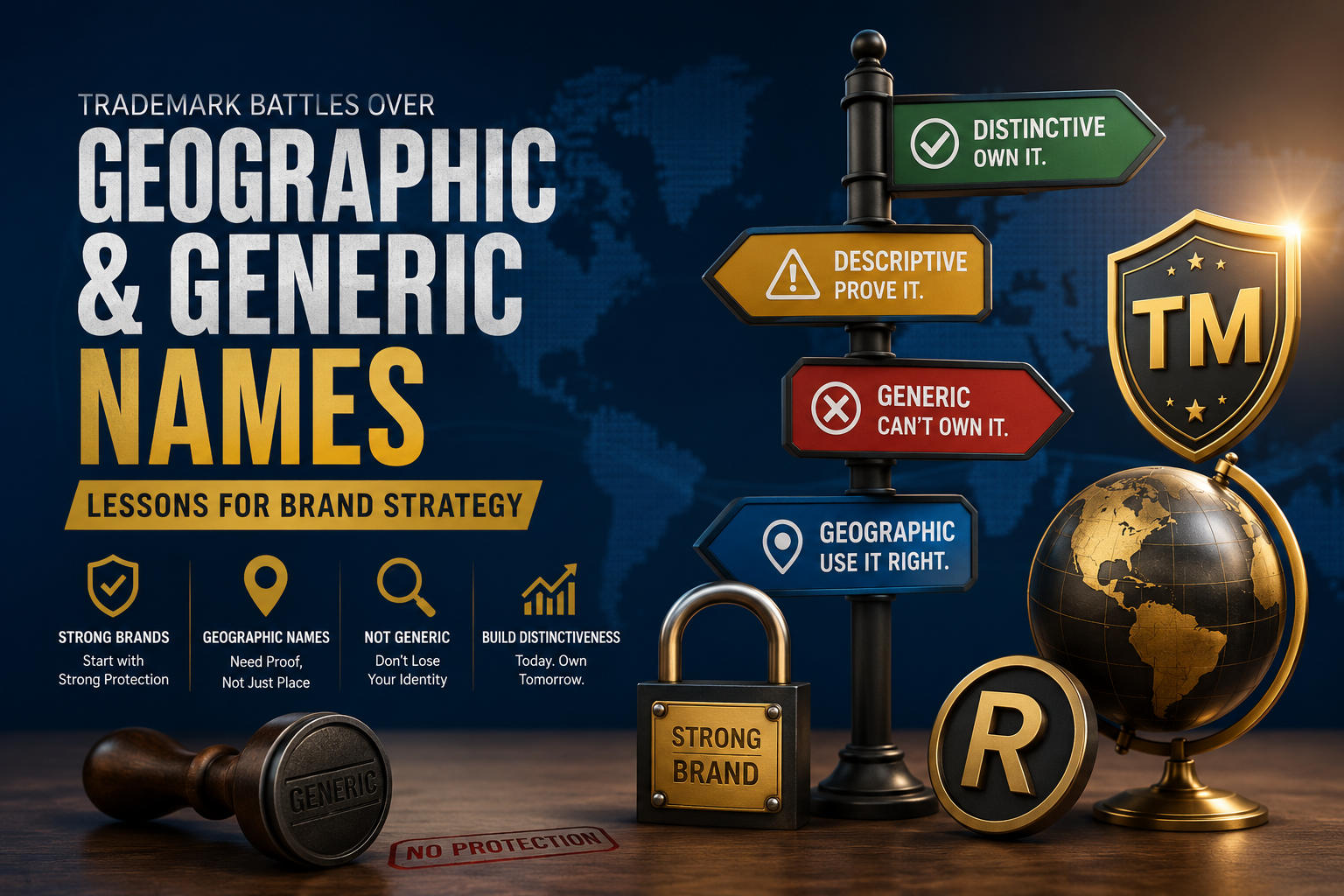
Trademark eligibility is evaluated across a standardized legal spectrum known as the distinctiveness scale. A mark's position on this spectrum determines its immediate registrability and the degree of enforcement power it will hold in a court of law.
- Generic Terms: These are the common everyday names for the goods or services themselves (e.g., "Computer" for laptops, "Clock" for timepieces). Generic terms can never receive trademark protection under any circumstances, as they lack any capacity to identify a specific commercial source.
- Descriptive Terms: These marks directly describe a characteristic, quality, function, purpose, or geographical origin of the product (e.g., "Creamy" for dairy products). These marks are initially refused registration unless the applicant can prove the name has evolved to signify a specific source to the public.
- Suggestive Terms: These marks hint at the nature, attributes, or benefits of the product without explicitly stating them, requiring a degree of consumer imagination (e.g., "Netflix" combining internet and movies). Suggestive marks are considered inherently distinctive and qualify for immediate protection.
- Arbitrary Terms: These consist of real words used in a context entirely unrelated to the actual goods or services sold (e.g., "Apple" for consumer technology). Because the word does not describe the product, it receives a very high level of legal protection.
- Fanciful Terms: These are entirely invented, coined words created solely for the purpose of acting as a trademark (e.g., "Kodak" or "Xerox"). These marks possess no pre-existing meaning and enjoy the absolute highest level of statutory protection against infringement.
Why geographical terms face strict statutory exclusions
The law generally prohibits the registration of primarily geographically descriptive terms to protect the public domain. If an enterprise establishes a business in a specific locality and attempts to register that locality's name as its trademark, registries will reject the application. This ensures that other local market participants retain the right to inform consumers where their goods are manufactured.
A more severe legal pitfall is the classification of a mark as "primarily geographically deceptively misdescriptive." This occurs when a brand incorporates a geographical location into its name for products that do not originate from that region, thereby misleading the consumer. For example, labeling an apparel brand as "Italian Luxury Tailors" when the goods are manufactured entirely outside of Italy represents a material misrepresentation that will result in an absolute refusal of registration.
Geographic names can only achieve trademark protection under narrow exceptions. The first is the arbitrary exception, where the geographical location has no logical or commercial link to the product itself (e.g., "Patagonia" for outdoor apparel). The second is through the accumulation of massive market presence over time, forcing a shift in consumer perception where the place name becomes synonymous with a single enterprise.
The generic trap and the permanent loss of rights through genericide
While starting with a generic name prevents an enterprise from ever securing intellectual property rights, an equal danger exists for highly successful brands: the phenomenon of trademark genericide. Genericide occurs when a highly distinctive, legally protected brand name becomes so commonly used by the public that it transforms into the generic description for the entire product category.
When a trademark transitions into a generic noun or verb within public discourse, the original owner loses exclusive rights, and the mark is legally canceled. Historical victims of genericide include formerly multi-million-dollar proprietary trademarks such as Aspirin, Escalator, Cellophane, and Videotape. In each case, the corporate owners failed to prevent the public from using their brand names as the common name for the underlying technology, resulting in the complete loss of their intellectual property assets.
To prevent genericide, companies must enforce strict brand guidelines. This includes ensuring that the trademark is consistently utilized as a proper adjective modifying a generic noun (e.g., "LEGO brand building bricks" rather than "Legos") and taking proactive legal action against media outlets or competitors that misuse the mark.
Acquired distinctiveness offers a narrow escape hatch for descriptive marks
For enterprises that have already invested heavily in a descriptive or geographic name, the primary legal mechanism for saving the mark is establishing "secondary meaning," formally known as acquired distinctiveness. This occurs when an otherwise unregistrable descriptive term becomes distinct through long-term, exclusive commercial usage, causing the consuming public to associate the name with a single specific source rather than the underlying description.
Proving secondary meaning to a trademark registry or a court is a highly technical, evidence-intensive, and capital-heavy process. An applicant must typically present clear evidentiary proof across several categories:
- Duration of Use: Demonstrating long-term, continuous, and completely exclusive use of the mark in commerce (often a statutory minimum of five years).
- Advertising Investment: Submitting extensive financial records detailing significant advertising and marketing expenditures dedicated to linking the name exclusively to the business.
- Consumer Survey Evidence: Introducing empirical data and market surveys demonstrating that a substantial percentage of the target consumer base identifies the descriptive term as a brand name rather than a product descriptor.
- Market Performance: Documenting substantial sales volume, market share, and unsolicited media coverage that confirms the brand's clear prominence in its sector.
Historical judicial battles illustrate the limits of protecting common words
The boundary between protectable brands and public language is continuously shaped by landmark judicial precedents. Analyzing these high-profile corporate disputes underscores the volatility of relying on common words for brand identity.
In the case of Booking.com v. USPTO, the United States Supreme Court addressed whether adding a generic top-level domain (".com") to an otherwise generic term ("Booking") could result in a protectable trademark. The patent office contended that the combination remained inherently generic. However, the Court ruled in favor of the business, establishing that if consumer perception treats a "generic.com" term as a specific brand rather than a category of services, the mark cannot be classified as generic. While a victory for the platform, the case highlights the extreme legal costs required to defend a descriptive naming architecture.
A different structural challenge is illustrated by the decades-long dispute between Apple Inc. and Apple Corps (the record label founded by The Beatles). Both entities utilized an identical arbitrary word ("Apple") but operated initially in entirely separate commercial classifications—consumer electronics and music production. As consumer technology evolved and Apple Inc. expanded into digital music streaming via iTunes, the boundaries between their respective trademark classes dissolved, sparking successive rounds of high-stakes litigation. The dispute demonstrates that even highly distinct arbitrary marks require precise classification management to avoid cross-industry liability.
Strategic steps to safeguard a brand using multi-layered IP portfolios
When market conditions or legacy constraints require an enterprise to operate under a descriptive or geographically vulnerable name, the business must construct a multi-layered intellectual property defensive strategy to safeguard its market share.
- Secure Distinctive Graphical Elements: If the literal words of a brand name cannot be protected, the business should immediately file for stylized or device marks. This protects the exact graphic layout, unique typography, custom iconography, and visual presentation of the logo, preventing competitors from duplicating the brand's visual identity.
- Implement a Composite Naming Architecture: Pair the vulnerable descriptive term with an inherently distinctive corporate "house mark" (e.g., combining a distinctive parent name like Microsoft with a descriptive product name like Surface). This ensures that the overall phrase achieves immediate eligibility for registration.
- Assert Proprietary Trade Dress: Establish and register the specific non-functional visual characteristics of the product’s packaging, interior design, or color combinations. This prevents competitor mimicry even if the literal name remains weak.
- Proactive Digital Real Estate Acquisition: Secure all principal top-level domain extensions and primary social media handles across global platforms to prevent digital poaching and consumer diversion by competitors, bypassing reliance on trademark enforcement tools alone.
International expansion introduces cross-border geographic indication risks
Enterprises scaling internationally must carefully distinguish between standard commercial trademarks and Geographical Indications (GIs). While a trademark is a private intellectual property right belonging to a single corporate entity to identify its specific goods, a Geographical Indication is a public collective right used to certify that certain products originate from a specific region and possess qualities, characteristics, or a reputation strictly attributable to that geographical territory.
Prominent examples of globally protected GIs include Champagne, Scotch Whisky, Parmigiano-Reggiano, and Darjeeling Tea. If a foreign enterprise attempts to market a product using a geographic term protected under an international GI framework—such as selling "California Champagne" or "American Feta"—it will face severe regulatory enforcement and immediate injunctions, particularly within the European Union. Courts treat GI violations as strict matters of consumer deception and unlawful competition rather than standard private trademark disputes, making cross-border geographic clearances mandatory for global operations.
Legal references explained
- Trade Marks Act: The foundational statutory framework governing the registration, protection, maintenance, and enforcement of trademarks within a specific jurisdiction (such as the Indian Trade Marks Act, 1999), outlining the absolute and relative grounds for the refusal of marks.
- Trademark Infringement: A statutory violation that occurs when an unauthorized third party utilizes a mark that is identical or deceptively similar to a prior registered trademark in relation to identical or similar goods or services, creating a distinct likelihood of consumer confusion.
- Passing Off: A common law tort actionable remedy utilized to protect the un-registered goodwill and reputation of a business from misrepresentation by competitors who attempt to pass off their own goods or services as those of the original business.
- Secondary Meaning / Acquired Distinctiveness: A legal doctrine whereby a non-distinctive, descriptive, or geographic mark becomes legally protectable because long-term, exclusive commercial usage has successfully conditioned the market to associate the term with a single source of production.
- Geographical Indication (GI): A form of intellectual property protection certifying that a given product originates from a specific geographical territory and possesses specific qualities, methods of production, or a reputation linked directly to that geographical origin.
- Genericide: The legal process by which a valid, registered trademark completely loses its distinctiveness and protective status because the public adopts the term as the generic common noun or verb for the entire product category.