MSME IP Reimbursement Scheme FY 2026-27: Foreign Patent Coverage Cap, IPFC Disbursement, and the Q3 2026 Industry Proposal Layer
MSME IP Reimbursement Scheme FY 2026-27: Foreign Patent Coverage Cap, IPFC Disbursement, and the Q3 2026 Industry Proposal Layer
The operative M/o MSME-administered reimbursement scheme is the "MSME Innovative Scheme – IPR Component", housed under the umbrella MSME Champions Scheme and disbursed by Intellectual Property Facilitation Centres (IPFCs). For an Udyam-registered Micro, Small or Medium Enterprise in FY 2026-27, the working reimbursement envelope covers domestic patent filings, foreign patent filings, GI registrations, designs and trademarks. The cap worth internalising across all five tracks is the ₹5.00 lakh foreign-patent ceiling.
What the Scheme Actually Covers in FY 2026-27
The MSME Innovative Scheme – IPR Component is the operative vehicle, sitting under the wider MSME Champions Scheme. Implementation runs through Intellectual Property Facilitation Centres (IPFCs) mapped across India; the portal of record is innovative.msme.gov.in, with the parent M/o MSME portal at msme.gov.in.
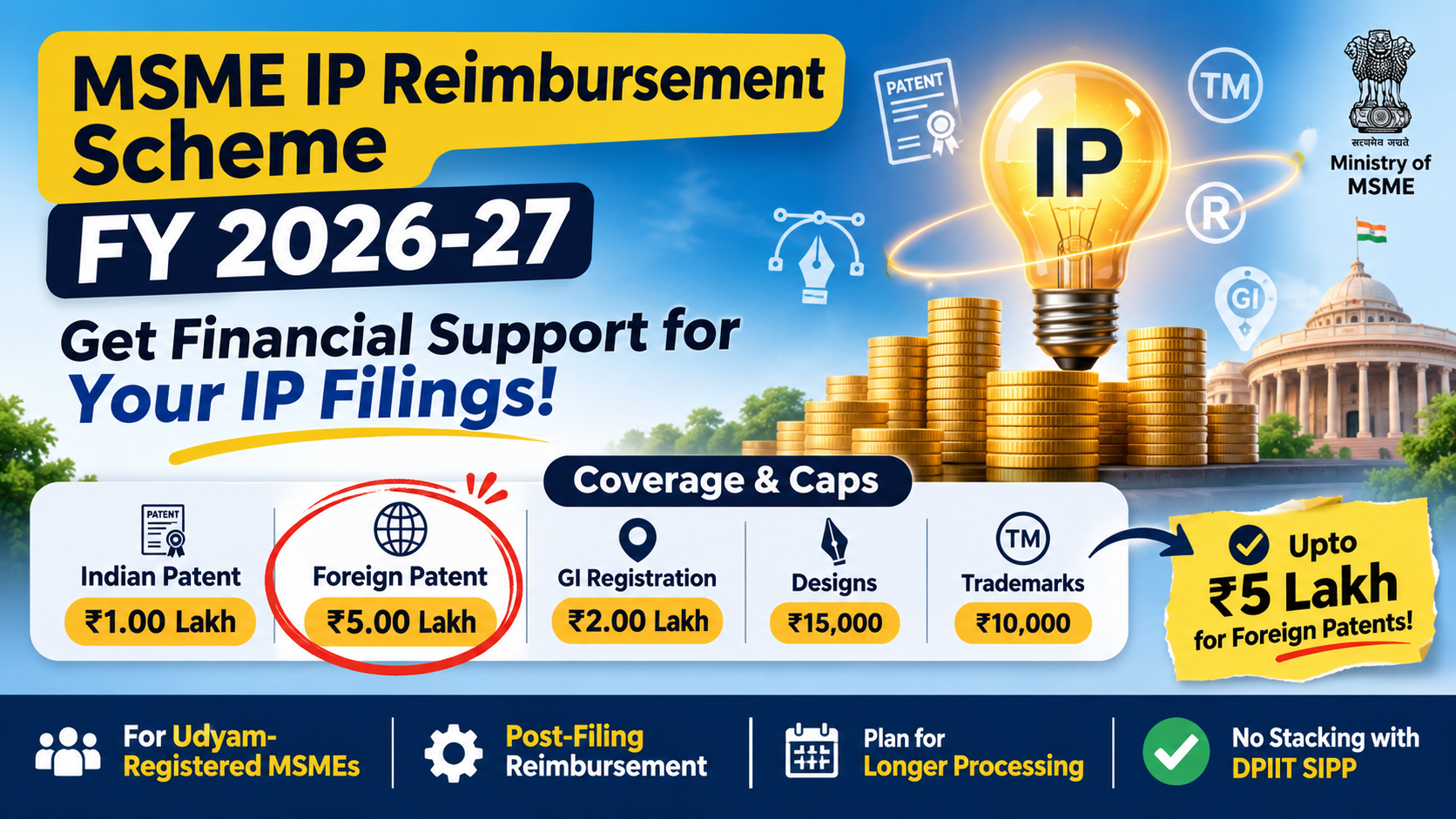
The working coverage grid for an Udyam-registered MSME is:
- Indian patent protection reimbursement: Up to ₹1.00 lakh (covering Form 1, Form 5 inventorship under Section 5, Form 9 early publication, Form 18 Request for Examination under Section 11B read with Rule 24B, and Form 27 triennial under Section 146 read with Rule 131(2)). The reimbursement follows official Schedule fees, not practitioner drafting charges.
- Foreign patent protection reimbursement: Up to ₹5.00 lakh (this is the cap that most published guides materially understate).
- Geographical Indication registration: Up to ₹2.00 lakh.
- Design registration: Up to ₹15,000.
- Trademark registration (TM-A): Up to ₹10,000.
- DPIIT SIPP Track: The DPIIT-adjacent Scheme for Intellectual Property Protection for Startups (SIPP) is structurally separate: startups use SIPP, while MSMEs use the Innovative Scheme IPR Component. The two pathways do not stack.
Disbursement Mechanics: How the Reimbursement Actually Pays Out
The current M/o MSME disbursement flow is sequential and post-verification. Under active guidelines, the MSME files the IP application, then submits official fee receipts, proof of filing or grant, and bank mandate forms to the cognate IPFC. The IPFC verifies the paper trail against official IP office records before M/o MSME releases the reimbursed amount. This is a post-filing or post-grant verification model, not a pre-grant tranche model. Plan FY 2026-27 budgets accordingly, as cash-flow processing runs in months rather than days.
The Q3 2026 Industry Proposal Layer
There is currently no published M/o MSME notification announcing a simplification round. What sector reporting and practitioner networks have flagged in Q3 FY 2026-27 is a set of industry proposals, not a published operative notification, that would shift disbursement toward a tranche-by-tranche schedule by aligning claims processing to the M/o MSME quarterly claim cycle. Until M/o MSME issues an official notification, these remain proposals rather than operative guidance. The conservative working assumption for an MSME client is straightforward: do not budget reimbursement inside the same fiscal year a Form 1 is filed, and do not promise fixed tranche payment dates.
Eligibility: Standard Udyam Thresholds Apply
All Udyam-registered Micro, Small and Medium Enterprises qualify under standard investment-and-turnover thresholds: up to ₹1 crore investment and ₹5 crore turnover for Micro; up to ₹10 crore investment and ₹50 crore turnover for Small; up to ₹50 crore investment and ₹250 crore turnover for Medium.
Eligibility is subject to non-duplication: the same expenditure cannot be claimed under both the MSME Innovative Scheme – IPR Component and the DPIIT SIPP scheme, or any other government reimbursement track. Most rejections on first claim submission stem from paper-trail issues, such as Udyam certificate currency or IPFC verification gaps, rather than substantive IP rejections.
What Has Not Moved
Three key structural realities remain unchanged for FY 2026-27:
- The Patent filing procession is unchanged: Form 1 to Form 18 filings under Section 11B and Rule 24B, as well as the 31-month Rule 20(4) PCT national-phase entry deadline, remain strictly binding and are unaffected by reimbursement mechanisms.
- Statutory rejection grounds remain binding: Sections 3(k) (software), Section 3(d) (polymorphs), Section 39 (foreign filing licence), and Rule 80 online annual renewal cadences apply regardless of reimbursement status.
- Udyam registration is the non-negotiable floor: Without an active Udyam Registration Certificate at
udyamregistration.gov.in, no claim can be filed.
Frequently Asked Questions
Are foreign patent filings covered under the MSME IP reimbursement scheme?
Yes. Under the MSME Innovative Scheme – IPR Component, foreign patent protection is covered with financial assistance capped at ₹5.00 lakh. By comparison, domestic Indian patents are capped at ₹1.00 lakh, GI registration at ₹2.00 lakh, designs at ₹15,000, and trademarks at ₹10,000. For PCT filings, reimbursement applies to the destination jurisdictions where the granted patent ultimately issues.
Does the DPIIT SIPP scheme stack with the MSME Innovative Scheme?
No. SIPP and the MSME Innovative Scheme – IPR Component are structurally separate programs designed for distinct entities: SIPP serves DPIIT-recognised startups, whereas the MSME Innovative Scheme serves Udyam-registered MSMEs. The same expenditure cannot be claimed under both tracks.
Is the Q3 2026 simplification round an official notification yet?
No. Industry discussions in Q3 FY 2026-27 reflect sector proposals for a tranche-by-tranche reimbursement model, but no formal M/o MSME notification has been published. Until an official order is issued, businesses should continue planning under the active post-verification reimbursement framework.